
• Skip to primary navigation
  • Skip to main content

James M. Redwine

  • Books
  • Columns
  • 1878 Lynchings/Pogrom
  • Events
  • About

Alvin P. Hovey

You Can Go Home Again and Again

January 1, 2023 by Peg Leave a Comment

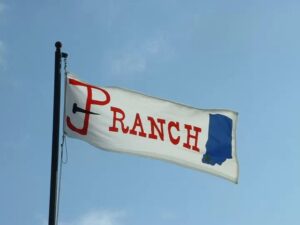
JPeg Ranch in Indiana. Photo by Peg Redwine

For many satisfying years Peg and I made our home in Posey County, Indiana among friends and family. During those years we were blessed with treasured visits from friends and family from out west, mainly my birth state of Oklahoma. Now that we have returned to make our home in Osage County, Oklahoma, as we reconnect with old friends and fond memories, we are occasionally blessed with visits from friends and family from southern Indiana. It is not frequent enough for us but is sweet when it occurs.

Therefore, we were pleased when we received an email from Mt. Vernon, Indiana high school senior, Carlton Redman, saying he had read our book JUDGE LYNCH! that we published in 2008, and for which my sister Jane nee Redwine Bartlett wrote the poignant Foreword. Carlton asked if I would participate in a Zoom call with his English class to discuss the book’s exposé of the long hidden horrific murders of seven Black men in Posey County in 1878; we were gratified for his interest. Carlton’s Redman family has deep roots in Posey County and his grandfather, Carl J. Redman, is an old friend of mine. Carlton’s uncle, Robert Redman, served as my court bailiff for several years. Another of Carlton’s uncles, Martin Ray Redman, was not only a fine public servant but also one of my best friends. Carlton’s cousin, Greg Redman, played baseball and graduated with our son, Jim, from Mt. Vernon High School. And, Dave Pearce along with his wife, Connie nee Redman Pearce, have carried my newspaper column, “Gavel Gamut”, in the Posey County News for many of the column’s 32 years and over 900 articles. In other words, unbeknownst to Carlton before he contacted me, the fine Redman family and my family have many pleasant connections and his aunt and uncle’s newspaper has often helped tell the story of the 1878 lynchings.

But that’s not why Carlton contacted me. He had been assigned by his teacher, Mary Feagley, to do a classroom project and he chose to investigate Posey County’s long and interesting history by reading our book and then having me appear in his class via the Internet on December 16, 2022 to discuss it. I was honored to do so as our son received a fine education from the Mt. Vernon school system and we have only good memories from his time there and our time in Posey County.
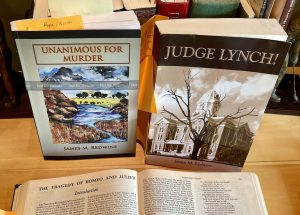
Photo by Peg Redwine

Gentle Reader, I hope you have read or will someday read JUDGE LYNCH! which is a historical novel, but refers to much of Posey County’s rich history. That Ms. Feagley has guided her students to know their own history gratifies but does not surprise me. Mt. Vernon High School has had several excellent teachers, such as Jerry King, who know our future is determined by our past and we need to know it, both good and bad.

In fact, Jerry and his wife, Marsha, appeared in the movie we made in 2011 about the murders of 1878. They reenacted General and Mrs. Alvin P. Hovey and even furnished their wonderful Pioneer Village for sets for the movie, for which my brother, C.E. Redwine, did the haunting music. Numerous Posey County and Evansville, Indiana residents volunteered their time and effort in the movie to help bring the previously hidden and forgotten terrible events of autumn 1878 to light. In fact, that movie premiered in my hometown of Pawhuska, Oklahoma at the Constantine Theater on June 11, 2011 at the First Ben Johnson Film Festival and has been shown several times in New Harmony, Indiana and elsewhere since then. JUDGE LYNCH!, its sequel, Unanimous for Murder published in 2021 that incorporates history from both Posey County and Osage County, and the movie are available at the Alexandrian Public Library in Mt. Vernon and Capers Emporium in New Harmony, Indiana. In Oklahoma they are available at the Pawhuska Public Library, the Osage County Historical Society Museum and Woolaroc Museum. And then, of course, from our website, www.jamesmredwine.com.

Carlton, his teacher and his classmates are helping the community remember what we must not forget, ignore or repeat. Thank you Carlton and Ms. Feagley. I was honored to serve forty years as a Posey County Judge and was honored to have JUDGE LYNCH! used to help preserve and expose our history.

Now that we live in Oklahoma we occasionally get to re-visit southern Indiana and see family and friends there. These times are rare but valued treasures, just as we used to feel when we lived in Indiana and visited Oklahoma. What Peg and I have found to our delight is that if one lives in both Posey County, Indiana and Osage County, Oklahoma, you have two homes and you CAN go home again, repeatedly.

“The Veranda” at JPeg Osage Ranch. Photo by Peg Redwine

Share this:

  • Click to share on Facebook (Opens in new window) Facebook
  • Click to share on X (Opens in new window) X
  • Click to email a link to a friend (Opens in new window) Email
  • Click to share on WhatsApp (Opens in new window) WhatsApp

Like this:

Like Loading...

Filed Under: Authors, Friends, Gavel Gamut, Mt. Vernon, Osage County, Posey County Tagged With: Alvin P. Hovey, Carlton Redman, family and friends, Gentle Reader, Home, James M. Redwine, Jim Redwine, JUDGE LYNCH!, lynchings, Mary Feagley, Mt. Vernon school system, murders of seven Black men, Osage County, Peg, Posey County, Posey County News, Unanimous for Murder, you can go home again

Hoosiers and Slave Auctions

August 3, 2018 by Peg Leave a Comment

Gentle Reader, you will, of course, remember the Gavel Gamut column of December 05, 2005 where one of Posey County, Indiana’s most infamous brawlers was mentioned. One Tom Miller was fond of drink and when drinking was fond of fighting. In the years just before the Civil War old Tom would get liquored up and lick whoever had the misfortune to run into him on the streets of Mt. Vernon, Indiana. As described by John Leffel in the Western Star newspaper Miller would, “Pace the streets of Mt. Vernon with his coat off, sleeves rolled up, his shaggy breast exposed and his suspenders about his waist.” According to the editor, Tom always bellowed the same challenge, “I’m a mean man, a bad man and I orter to be whipped, I know, but whar’s the man to do it?”

Tom Miller was only one small part of our Posey County and new state of Indiana’s reputation for tumultuous living. The sobriquet, “Hoop Pool Township”, was fairly earned by Posey County brawlers who drove visiting boatmen away. And as for frontier justice in Indiana, some experts assert our Hoosier nickname came about from the proclivity of Indiana rowdies to bite off ears and spit them out onto barroom floors.

I am indebted to columnist Erik Deckers who set forth this theory of the origin of the word “Hoosier” in his article contained in the publication Here and Wow, Indianapolis! Vol.1, No. 1, 2018. At page 22 Deckers attributed this possibility to Indiana’s poet laureate James Whitcomb Riley (1849-1916) of When the Frost is on the Pumpkin fame who claimed that early Indiana folks would frequently gouge out eyes or bite off body parts which would litter a barroom floor and when the next day someone would kick the removed piece of fleck they’d ask, “Whose ear?”

If I had not dealt with so many cases in court where the behavior of the combatants resembled such activity I might look askance on such a theory. However, I can see some merit to Riley’s analysis.

Well, onto another topic as discussed in last week’s column. You do remember last week’s column, right? Okay, it involved military service and concentrated on my Great Great Grandfather, John Giggy who was a stone mason and farmer from La Grange, Indiana who fought all four years (1861-1865) in Company H of the famed Iron 44thIndiana Volunteer Infantry.

Before being wounded at both Shiloh and Chickamauga and before he saw his first shot fired he and his outfit witnessed a sad spectacle in Henderson, Kentucky that helped them understand one of the main reasons they went to war. Kentucky did not secede, but it did have legal slavery until 1865. In fact, one reason Tom Lincoln, Abraham’s father, moved his family from Kentucky to Indiana was to avoid competing for work with slave labor. Slavery was part of the legal and social culture of Kentucky. The young Hoosier farm boys from northern Indiana who were used to doing their own labor had not had direct knowledge of The Peculiar Institution until they personally observed a slave auction in 1861 just across the Ohio River as they were making their way south:

“It was a strange pitiful sight that of women and little children standing upon the action block to be sold as human chattles. They came wringing their hands and with tears and sobs, lamenting their cruel fate. The soldiers stood near filled with pity and indignation but restrained by law and discipline. Slavery existed at this point in its mildest form. Here were a dozen or more large tobacco factories. The blacks were required as a daily task to strip 400 pounds under penalty of the rod. Children of ten years were given this task. Work hours extended from 4 a.m. to 8 p.m. In each room was an overseer whose presence was a threat. Some negroes were well dressed, others ragged. Attendance at church was allowed and many were Christians. They regarded the coming of the soldiers as the precursor of their liberty.”

As to the name Hoosier, Posey County’s most famous citizen, Major General Alvin P. Hovey, while in command at Shiloh came across a Union sentry on a dark night who asked for the password. Hovey was just getting his men to that position and had no idea what password was being used. When the sentry asked, “Who goes there?”, Hovey improvised what he hoped would be an acceptable password and responded, “Hoosiers”. The sentry said, “Welcome Hoosiers.” Apparently, we Hoosiers have been welcomed as such for a long time.

Share this:

  • Click to share on Facebook (Opens in new window) Facebook
  • Click to share on X (Opens in new window) X
  • Click to email a link to a friend (Opens in new window) Email
  • Click to share on WhatsApp (Opens in new window) WhatsApp

Like this:

Like Loading...

Filed Under: America, Gavel Gamut, Indiana, Mt. Vernon, Mt. Vernon, News Media, Posey County, Slavery Tagged With: Abraham Lincoln, Alvin P. Hovey, Chickamauga, Civil War, Company H of the Iron 44th Indiana Volunteer Infantry, Gentle Reader, Henderson Kentucky, Hoop Pole Township, Hoosiers, Indiana, James M. Redwine, James Whitcomb Riley, Jim Redwine, John Giggy of La Grange Indiana, John Leffel, Mt. Vernon, Posey County, Shiloh, slave auctions, slavery, Tom Lincoln, Tom Miller, Western Star

Do Right While We Help Ourselves

August 12, 2017 by Peg Leave a Comment

If you read last week’s column (hey, I can dream can’t I), you know I am preparing to help the National Judicial College teach Rural Court Judges. Last week we talked about the theory that our law arises from our history and culture, our Volksgeist. Or as Oliver Wendell Holmes, Jr. (1841-1935) put it, “The life of the law has not been logic; it has been experience”.

Posey County, Indiana has produced several influential thinkers on what our law should be and do, that is, what is the proper purpose of our legal system? Our most famous citizen was and still is Alvin P. Hovey (1821–1891). Hovey was an attorney, a Posey Circuit Court judge, a general and the only governor to ever come from Posey County (1889–1891). He also sat on the Indiana Supreme Court when it decided a poor person was entitled to the same protection of our laws as a rich person.

Another of our famous predecessors was the brilliant and courageous Frances (Mad Fanny) Wright (1795–1852) who gave her entire adult life to an effort to free slaves and secure equal rights for women. Unfortunately, her good deeds were often overshadowed by her lifestyle. Still she fought for those who could not fight for themselves.

Frances Wright’s companion and fellow traveler was former Congressman Robert Dale Owen (1801–1877). Owen knew Abraham Lincoln from having served in Congress in 1843–1847 while Lincoln served in Congress 1847–1849. Owen’s 1863 letter to Lincoln urging him to free the slaves is credited with influencing the President to issue the Emancipation Proclamation.

Robert Owen and Alvin Hovey were also Posey County’s delegates to the Indiana Constitutional Convention of 1850–1852 that produced our 1852 Constitution in which our legal system demands fair and equal treatment regardless of a person’s ability to pay. The Preamble sets forth the first principle of our government is to establish justice and, as set forth in Article I, “That all people are created equal”.

Article I, Section 12, guarantees equal justice to rich and poor alike: 

“All courts shall be open and every person for injury done to him in his person, property, or reputation, shall have remedy by due course of law. Justice shall be administered freely, and without purchase; completely, and without denial; speedily, and without delay.” 

While there are many reasons we need justice from our legal system, I suggest the two most important areas concern whether our government wants to lock us up or take away our children. Of course, there are many wealthy people who are charged with crimes and even some wealthy people who the rest of us believe should lose their children to state care. However, it is simply a fact that most people who go to jail are poor as are most parents whose children are removed by the courts.

It is usually the poor and powerless who are caught up in the terrifying, confusing and expensive legal system. And frequently these poor people are not highly educated nor do they have friends in high places. They need help and both Indiana and federal law guarantee that help to them, including representation by an attorney. If the rest of us want to lock someone up or take away their children, the least we can do is follow the law ourselves and provide these people with legal assistance as our Constitutions demand. This is not only required by law, fair, just and reasonable, it is good for all of us. If the innocent are not locked up or the guilty are fairly sentenced or children are not removed when unnecessary or when necessary are removed carefully and with efforts to help the children and the parents, such justice is in our own self interest. In other words, not only is it right, it is smart and in the long run saves us money as it helps people recover so they may contribute to society. And it helps families remain united or reunite.

If we can spend trillions on matters beyond our borders, we should not be mean-spirited and self-destructive with our own citizens. Plus, it complies with the law, especially those state and federal Constitutions some of us are fond of saying we revere.

Share this:

  • Click to share on Facebook (Opens in new window) Facebook
  • Click to share on X (Opens in new window) X
  • Click to email a link to a friend (Opens in new window) Email
  • Click to share on WhatsApp (Opens in new window) WhatsApp

Like this:

Like Loading...

Filed Under: America, Circuit Court, Democracy, Gavel Gamut, Internet class, Judicial, Law, National Judicial College, Posey County, Rule of Law Tagged With: Abraham Lincoln, Alvin P. Hovey, Congress, Congressman Robert Dale Owen, Emancipation Proclamation, equal rights for women, fair and equal treatment regardless of person's ability to pay, fair just and reasonable, Frances (Mad Fanny) Wright, free slaves, general and governor from Posey County, Indiana Constitutional Convention of 1852, Indiana Supreme Court, James M. Redwine, Jim Redwine, legal system, National Judicial College, Oliver Wendell Holmes Jr., poor people, Posey Circuit Court Judge, Posey County Indiana, required by law, Rural Courts Judges, volksgeist, wealthy people

© 2025 James M. Redwine


Loading Comments...
 

    %d