When our son, Jim, was stationed with the U.S. Army in Germany he visited the old Soviet Union just before the collapse of the Berlin Wall in 1989. He told us the very few other Americans he saw in what became modern Russia were easy to spot; they were the only ones smiling. I noticed that same phenomenon among the public when I worked for a couple of weeks in the Republic of Ukraine in 2000. Then when Peg and I spent a week working in Russia in 2003 we noted everyone but the two of us wore dark clothes and dark expressions.
Our recent eight-month experience working with the judiciary in the Republic of Georgia, once part of the old Soviet Union and bordering Russia, reinforced these impressions of uncertainty given out by the Georgian people who are ostensibly in a now free and democratic country; however, they appeared to us to be hedging their bets due to fear of their Russian neighbor.
Peg and I could not have been treated any more courteously than we were by our new Georgian friends who were generous and great fun to live and work among. We had a marvelous experience and learned a great deal. One thing we already knew, but had not fully appreciated until sharing with the Georgians whose small country is across the Black Sea from Ukraine, was how fortunate we are as Americans to not only be free but to feel free.
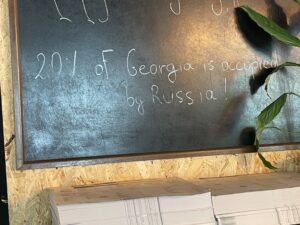
The people of Georgia were open and friendly with us whether at court, our other meeting places or on the streets. We were fully accepted, often objects of curiosity and were constantly asked, “How are things done in America?” You see, Gentle American Reader, Russia occupies 20% of the “Republic” of Georgia and is a constantly looming presence, at least mentally, in most Georgian psyches. Freedom there is established by law but is quite uneasy. The friendliness and good will of the countless Georgian citizens we worked and socialized with was unforced and generous. However, our Georgian acquaintances usually found an opportunity to express their good will and appreciation toward America and their almost universal desire to come here. It was reassuring and gratifying to experience how other people respected our home country.
I guess it is sort of like Mark Twain’s epiphany, “When I was a teenager, I could not believe how ignorant my father was, but by the time I turned 21 I was amazed at how much the old man had learned.” In much the same manner, Peg and I were brought to fully appreciate living in a truly free country. It is one thing to be physically in a country called a democracy, and it is an entirely different feeling to live in America where, as Lee Greenwood sings, “I am proud to be an American where at least I know I’m free.”
The dreams and aspirations of our new Georgian friends also affected our understanding of people risking their lives and sacrificing everything to get to America, you know, as many of our ancestors did. Even native-born Americans such as Peg and I owe huge debts to the brilliance and courage of many immigrants and their progeny who helped make these United States, as Katherine Lee Bates and Samuel A. Ward wrote in America the Beautiful, “Oh beautiful for pilgrim feet whose stern impassioned stress, a thoroughfare for freedom beat across the wilderness.”
Or as Frances Williams and Marjorie Elliot in their song Hymn to America, Let There Be Music called for, an America where, “May kindness and forbearance make this land a joyous place, where each man feels a brotherhood, unmarred by creed or race.” We recognize our country’s imperfections and sins of the past and present. But, America’s beacon of freedom expiates many of our failings. And, once one leaves America she or he understands why regardless of our shortcomings, as Neil Diamond sings, “From all across the world they’re coming to America.” Why? Because, “They only want to be free.”
Gentle Reader, haven’t you often wished you could travel back in time to when our country was founded? Wouldn’t it be something special to meet and talk with such dreamers, heroes and revolutionaries as George Washington, Thomas Jefferson, John Adams, James Madison, Alexander Hamilton and others? Perhaps we could have even joined in that difficult and dangerous struggle for freedom that now we can only read about, but thanks to them and others, we enjoy every day. Of course, who knows if we would have dared join in that revolt against Great Britain, the most powerful nation on earth in the 1700’s. And if we had lived then and had shown the courage of our Forefathers, we as they might have been blind to the hypocrisy and irony of fighting for our own freedom as we denied Native Americans, Blacks and women theirs. Heroes do not have to be perfect to strive for, “[A] more perfect union.”
Many of our Georgian friends are publicly standing up to a large portion of their government that has chosen to abide by Russia’s infiltration into Georgia. It takes courage to risk freedom to seek freedom. A large portion of the Georgian government is sympathetic to Russia while the majority of the citizens yearn for a true freedom that does not require a subtle fealty to what remains of the old Soviet Union.
Peg and I were impressed by the bravery of our Georgian friends and, especially, the boldness of the women. It reminded us of what it might have been like to know Martha Washington, Martha Jefferson, Abigail Adams, Dolly Madison and Eliza Hamilton. You know, our Founding Mothers, without whom we in America might well be the Georgians of today, “Yearning to be breathe free.” I will not name our courageous Georgian friends, both women and men, as the penalties for seeking a true democracy may well be severe. But I do admire their willingness to risk all for what our Founders risked for us. When Peg and I finally returned to Osage County, Oklahoma, U.S.A. we found ourselves gratefully humming that song by Woody Guthrie about America’s birthright, This Land Is Your Land. Apparently even depression era America felt good as long as it was free; freedom renders hardships bearable.
Our time working abroad showed Peg and me we had to leave America to truly appreciate what it might feel like to lose it. We are products of the 1960’s and have long recognized and often pointed out the U.S.A. is not perfect. But no place is and it sure beats all the alternatives we have seen. As for our Georgian friends, many of them are concerned that Russia will not respect Georgia’s 8,000 years of history and tradition and will seek to control the remaining 80% of that beautiful but small and vulnerable country.
That the concerns of numerous of our Georgian friends are well justified has been recently validated by the ruling political power’s attempt to push through two Russian influenced statutes that sought to prohibit and punish “foreign influence.” Due to strong public protests that some of our Georgian colleagues joined, the ruling party withdrew the bills, for now. However, under these proposed draconian laws, as Americans sent to Georgia to help Georgia’s judges seek more independence, Peg and I might well have come under scrutiny for our actions since our mission was fully funded by the United States Agency for International Development, the American Bar Association and the East-West Management Institute, all of which could be classified by Russia or the Georgian Parliament as “foreign influencers.” Judicial Independence is not a goal of Georgia’s controlling political party. Peg and I are glad to be home but are concerned about our Georgian friends as there is still much important and difficult work to be done and we hope America continues to “influence” our friends’ courageous efforts to do it.