
• Skip to primary navigation
  • Skip to main content

James M. Redwine

  • Books
  • Columns
  • 1878 Lynchings/Pogrom
  • Events
  • About

Christianity

Ah, Spring!

April 16, 2025 by Peg Leave a Comment

Joseph Campbell (1904-1987) was one of America’s best-known authorities on the universality and similarity of religions and myths we humans have created and lived by for hundreds of thousands of years. Campbell saw these recurring cultural explanations and superstitions as deeply imbedded in our daily lives. One similarity many of these phenomena have is they often center around springtime. While mankind has left countless records of beliefs in supernatural beings long before Judaism, Christianity and Islam, these three currently ascendant faiths each reflect the significance of spring’s influence, especially in stories of rebirth. The famous prosecutor of the Charles Manson Family, Vincent Bugliosi (1934-2015), even based his understanding of Manson’s motives for murdering people he did not even know on Manson’s convoluted interpretation of the Biblical Rapture myth (Revelation: Ch. 14, 15-20).

In the springtime, Jews celebrate Passover with eight days of special prayers and a Seder supper. The Judaic legend is that God gave Moses the laws of the Torah and Moses passed those commandments for living onto the Jewish people. The Torah is the record of those guidelines.

Christians celebrate their belief in a promised rebirth and their God’s instructions on behaving, as delivered directly from God – the Son, Jesus. Christians have a period of Lent leading up to Easter Sunday and an Easter dinner. The New Testament contains those principles to live by.

Muslims venerate the Quran as the word from their God spoken through Muhammad for a period of time they call Ramadan. Each day starts with a meal, Suhar, then a period of fasting ending with a second meal, Iftar.

Jews and Muslims view themselves as descendants from the same progenitor, Abraham, and worship the same God. Christians also worship that God but further deify Jesus as God. These ostensibly symbiotic religious phenomena have not produced consistently symbiotic relationships between and among the three groups.

Repentance, reflection, prayer, forgiveness, generosity, hope and joy are some of the elements in each of these three religions springtime celebrations of rebirth. For Christians, Easter Eggs are a ubiquitous symbol of what many so-called pagan cultures use to represent these same important rituals.

However, springtime is not just for organized religions. It may be mere coincidence that our government sees springtime as a propitious time to suck tribute from us, but I doubt it. When April 15 rolls around the IRS starts its period of concentrated accounting for any money we may have somehow managed to stash aside. It is time for what President Abraham Lincoln, the creator of the income tax to finance the Union’s Civil War, called “A new birth of freedom”, yeah, right.

Call me a cynic, but I do not see it as a mere happenstance that as most of America is awash in the good feelings brought on by Passover, Ramadan and Easter our government is demanding from us what it wants to spend on its own priorities. I see method in the timing of TAX-TIME and spring flowers. I am even a little superstitious that the first hummingbird that appeared at Peg’s feeder showed up April 15. Its avaricious slurping reminded me of other blood suckers that appear for “rebirth” along with the dandelions.

Share this:

  • Click to share on Facebook (Opens in new window) Facebook
  • Click to share on X (Opens in new window) X
  • Click to email a link to a friend (Opens in new window) Email
  • Click to share on WhatsApp (Opens in new window) WhatsApp

Like this:

Like Loading...

Filed Under: Authors, Events, Gavel Gamut, Religion Tagged With: Abraham, April 15, Charles Manson, Christianity, Easter, Iftar, IRS, Islam, James M. Redwine, Jesus, Jim Redwine, Joseph Campbell, Judaism, Lent, Lincoln, Muhammad, myths, Passover, Quran, Ramadan, Rapture myth, rebirth, religions, Seder, Spring, Sugar, tax-time, Torah, Vincent Bugliosi

Believe It Or Not

September 6, 2024 by Peg Leave a Comment

How does a new religion get started? Islam fourteen hundred years ago? Christianity two thousand years ago? Judaism twenty-four hundred years ago? The Romans and Jupiter twenty-five hundred years ago? The Greeks and Zeus three thousand years ago? The Egyptians and thousands of gods four thousand years ago? Gentle Reader, these are just my guesses; you are, of course, free to make your own estimates or consult Google as you see fit.

However, my actual concern is the religion of presidential politics as practiced currently on cable TV in America. And I know when these new beliefs began. With FOX News, the new Defender of the Conservative Faith arrived when Donald Trump came down that golden escalator in 2015. As for CNN and MSNBC, their faith in a Liberal Deliverance was restored only a couple of months ago when Kamala Harris arose like the mythical Phoenix from the ashes of Old Joe.

As best I can tell, the liturgy of these conflicted beliefs relies heavily on denigrating whichever candidate a particular TV network does not like. Portentous warnings from talking heads claim that the election of the “wrong” candidate will cause crops to fail and Taylor Swift to become the new Pied Piper of American youth.

These dire warnings from CNN, FOX News, MSNBC and even occasionally, PBS, have become as ubiquitous as commercials and as vociferous as a Pentecostal sermon. CNN convenes numerous panels of “Never Trumpers” who have heard directly from on high that a Trump election will immediately boot America from our Promised Land. And FOX asserts that a Harris win will reign fire and brimstone all over our democratic Garden of Eden, or at least, everywhere but New York and California.

But, just as one religion after another from the dawn of recorded history has appeared and disappeared, we can all pray that this election will end before Armageddon begins. I foresee hope for salvation from this endless cacophony of vapidity, FOOTBALL! As we Americans have done since the first football game was aired on TV, we clutch at the hope our team will rise above the fray. We can seize onto the faith in our champions on the gridiron and set aside the ennui brought on by the gaggle of gloom bearers on TV. Unfortunately, football season only lasts through the Super Bowl in February of 2025. Of course, the networks are doing their best to force us to buy every game and the new Transfer Portal and Name, Image and Likeness rules are sorely testing our faith.

And, of course, whoever wins the election will be subject to four years of damnation from some of the disappointed anchors. Those sore losers will likely begin endless recriminations for venal sins they assert just over half of the electorate will have committed by worshipping a false idol. As for us in the captive viewership, maybe the INSP network will have enough Gunsmoke reruns to sustain us until the next two graven images are nominated four years from now.

Share this:

  • Click to share on Facebook (Opens in new window) Facebook
  • Click to share on X (Opens in new window) X
  • Click to email a link to a friend (Opens in new window) Email
  • Click to share on WhatsApp (Opens in new window) WhatsApp

Like this:

Like Loading...

Filed Under: Elections, Football, Gavel Gamut, Presidential Campaign, Religion Tagged With: Christianity, CNN, Egyptians and gods, football, Fox News, Gentle Reader, Greeks and Zeus, Gunsmoke reruns, Harris, INSP, Islam, James M. Redwine, Jim Redwine, Judaism, MSNBC, Name Image and Likeness, PBS, Presidential politics, religion, Romans and Jupiter, Transfer Portal, Trump

Hot Lead or Cold Water

November 29, 2021 by Peg Leave a Comment

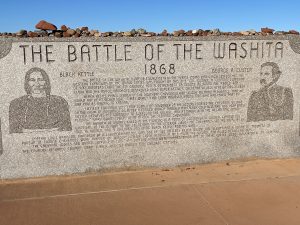
At the Washita Battlefield, November 21, 2021. Photo by Peg Redwine

Charles Brill’s account of the November 27, 1868 incident between Black Kettle’s Cheyenne tribe and U.S. 7thCavalry troops led by Lt. Col. George Custer is entitled, Conquest of the Southern Plains: Uncensored Narrative of the Washita and Custer’s Southern Campaign. Brill’s 1938 publication relied on eyewitness accounts from aged Indian survivors of the conflict. Brill personally took Cheyennes Magpie and Little Beaver and Arapaho Left Hand along with government interpreter John Otterby, a.k.a. Lean Elk, to the site of the attack. This article relies on the 2001 republication of Brill’s accounts by the University of Oklahoma Press re-titled Custer, Black Kettle, and the Fight on the Washita.

The fertile Washita River valley area on the western edge of Indian Territory (Oklahoma) had been a common peaceful wintering ground for numerous Indian tribes for countless years before 1868. There was an abundance of water, game, shelter and vegetation. It was also an area set aside for the Indians in several treaties with the United States between Black Kettle’s Cheyenne and other tribes. On the bitterly cold, snow-covered morning of November 27, 1868 the Indians’ only concerns were keeping warm and tending to their horses. Then Custer’s seven hundred mounted soldiers came charging at the sleepy Indians from all sides with rifles blazing and sabers slashing.

Black Kettle & Medicine Woman Later Crime Scene. Photo by Peg Redwine

Black Kettle was alerted by a woman who had been tending to the horses and first saw the approaching soldiers. When she yelled out “Soldiers, soldiers!”, Black Kettle fired a warning shot with his rifle to awaken the camp. Then Black Kettle drew his wife, Medicine Woman, up behind him on his pony and attempted to flee as he and Medicine Woman shouted warnings to the camp. He and Medicine Woman were then shot and killed. Magpie, one of the eyewitnesses Brill relied upon, heard Black Kettles’ warning shot and exited his lodge just as he heard a trumpet blast from the nearby trees and then saw the mounted soldiers charging into the village from all sides. Magpie was shot in the leg but managed to escape death by entering the freezing water and hiding in the brush along the banks.

As reported by Brill at page 159:

“From every side came the heavy report of carbines. Occasionally an Indian rifle answered. But these were notable for their infrequency. So sudden had been the attack, only a few of the red men had opportunity to arm themselves. Most of those who did so had only bows and arrows. They were powerless to offer serious resistance. Flight was their only objective.

Those villagers whose tepees stood nearest the stream fared better than their friends in the center and on the south side of the camp. First to dash through the icy waters of the Washita and scramble up the opposite bank found themselves running into scouts and sharpshooters who had deployed in the timber there. They also encountered troopers, mounted and dismounted. Seeing escape shut off in that direction, the fugitives accepted the only avenue left open to them, the channel itself. It was misery to wade its ice-fringed waters, but it was either that or bullets.

Women and children, as well as braves, plunged into the stream. Most of them were scantily clad. Many were without moccasins on their feet. Frequently the water reached to the armpits of adults who had to carry the children through these deep pools to prevent their drowning. Desperately they splashed their way beyond the lines of their enemies.”

Sometimes the fog of history eventually is pierced by uncomfortable facts. The Washita massacre was originally reported as a great military victory over savage foes by courageous heroes. Those reports originated from the “heroes”. The facts managed to slowly ooze out over a great deal of time. Those facts established the betrayal of morality and violations of treaties. They do not tell us, “Why?” The reasons may be explained by Pawnee attorney and scholar of law and history Walter R. Echo-Hawk in his book on bad court cases involving Native American treatment by the dominant white culture.

In the Courts of the Conquerors, The 10 Worst Indian Law Cases Ever Decided contemplates the roots of the doctrine of Manifest Destiny and its raison d’être, The White Man’s Burden:

“A popular justification for colonialism among the colonizing nations was the white man’s burden. Originally coined by Rudyard Kipling, the term is a euphemism for imperialism based upon the presumed responsibility of white people to exercise hegemony over nonwhite people, to impart Christianity and European values, thereby uplifting the inferior and uncivilized peoples of the world. In this ethnocentric view, non-European cultures are seen as childlike, barbaric, or otherwise inferior and in need of European guidance for their own good. As thus viewed from European eyes, colonization became a noble undertaking done charitably for the benefit of peoples of color.” See p. 16

The concept of exterminating Native American culture as justified because it was replaced with the blessings of Christianity and civilization is hardly a new idea. The Romans by force of arms visited their supposed superior culture on “lesser” peoples as have many dominate societies for thousands of years. The germ of “destroying a culture to save it” is easily discovered by any powerful society that wants to take what some weaker society has. However, that there was ample precedent for the massacre at the Washita does not expiate Custer’s assault and does not obviate the moral imperative to remember it.

Washita Battlefield. Photo by Peg Redwine

Share this:

  • Click to share on Facebook (Opens in new window) Facebook
  • Click to share on X (Opens in new window) X
  • Click to email a link to a friend (Opens in new window) Email
  • Click to share on WhatsApp (Opens in new window) WhatsApp

Like this:

Like Loading...

Filed Under: America, Events, Gavel Gamut, Justice, Manifest Destiny, Massacres, Military, Native Americans, Oklahoma, United States, War Tagged With: 7th Cavalry, Black Kettle, Charles Brill, Cheyenne, Christianity, destroying a culture to save it, George Custer, James M. Redwine, Jim Redwine, Manifest Destiny, Medicine Woman Later, Romans, Walter R. Echo-Hawk, Washita Battlefield, Washita River

Connections

October 13, 2017 by Peg Leave a Comment

Father George Rapp of Pennsylvania and Robert Owen of New Lanark, Scotland each hoped their visions for Mankind would manifest in New Harmony, Indiana. Rapp’s vision involving Christ’s Second Coming and Owen’s involving a world without any traditional religions look different but have similar dreams at their base. A world without private property ownership was one of the major goals for both.

I will leave an analysis of Rapp’s grand plans to the theologians. As to Owen’s, I defer to the philosophers but will refer to Robert Owen, A View of Society and Other Writings edited by Gregory Glaeys who is a Professor of History at Royal University of London and a recognized authority on Robert Owen.

According to Glaeys, Robert Owen (1771-1858) was one of the greatest British social reformers and was a pioneer in schemes for humane factory management, the eight-hour workday and the education of the poor. Owen even now remains respected as a pioneer socialist, feminist and advocate of an ecological approach to industry and urban life.

One of the most interesting ironies of the connections between the philosophies of Rapp and Owen and New Lanark and New Harmony is that the clergy was one of Owen’s fiercest opponents. Yet elements of Rapp’s Christian thought and Owen’s abhorrence of Christianity and all other organized religions intertwine, especially their mutual calls for a new world order and disdain for economic competition and individualism. Perhaps that was why and how Owen and Rapp knew of one another and what led to Owen in New Lanark, Scotland buying Rapp’s town of New Harmony, Indiana.

Glaeys describes that transaction as follows:

“In 1825 he (Owen) purchased a ready-made community set on 20,000 acres in southern Indiana from a pietistic German sect, the Rappites. At New Harmony he spent about 40,000 pounds (about $240,000) or four fifths of his New Lanark fortune in a fruitless effort to organize a disparate group of about 800 radicals, freethinkers, backwoodsmen and scientists.”

p. xvi

Unfortunately, too many of the 800 thought Owen’s utopian concept simply meant they could do nothing and Owen would support them. These ingrates had ample reason for this attitude based on Owen’s own creed as set forth in his Manifesto:

“Individual and national competition and contest are the best modes (under the then existing circumstances) by which wealth can be created and distributed.

….

But it is obtained by creating and calling into full action, the most inferior feelings, the meanest faculties, the worst passions, and the most injurious vices which can be cultivated in human nature.”

p. 358

Owen sought a system of production and distribution that called for “…[T]he least labour to all members of a society, and especially with the least amount of unhealthy and disagreeable employment.”

Well, Gentle Reader, you can probably see how such an experiment might turn out. You are right. In about two years Owen’s heaven on earth was more akin to Purgatory. And Owen’s insistence on a strict compliance to his principles on his terms did not engender enthusiastic compliance. Or as the ancient Greeks might have observed, hubris is a mortal flaw.

There is so much more to Robert Owen and the symbiotic relationship between New Lanark, Scotland and New Harmony, Indiana than can be crammed within a few newspaper columns. However if you care to hang around awhile I plan to cram some stuff into my next few epistles.

But before the following weeks’ offerings, I must address last week’s column thanks to our friend and Robert Owen authority, Linda Warrum from New Harmony. Linda read last week’s column and offered some advice. First, Linda, thanks for reading Gavel Gamut; you have doubled my audience. Secondly, thanks for pointing out not all of Robert Owen’s children were given the middle name of Dale and Father Rapp’s group were not German Lutherans but Pietists who, “…[E]mphasized personal piety over religious formality and the orthodoxy of the Lutheran Church.” It was nice of Linda to both read Gavel Gamut and respond.

Share this:

  • Click to share on Facebook (Opens in new window) Facebook
  • Click to share on X (Opens in new window) X
  • Click to email a link to a friend (Opens in new window) Email
  • Click to share on WhatsApp (Opens in new window) WhatsApp

Like this:

Like Loading...

Filed Under: Gavel Gamut, New Harmony, New Lanark Tagged With: A View of Society and Other Writings, Christ's Second Coming, Christianity, education of the poor, Father George Rapp, feminist, Gregory Glaeys, humane factory management, James M. Redwine, Jim Redwine, New Harmony Indiana, New Lanark Scotland, pietist, Robert Owen, socialist, the eight-hour workday

© 2025 James M. Redwine


Loading Comments...
 

    %d