• Skip to primary navigation
  • Skip to main content

James M. Redwine

  • Books
  • Columns
  • 1878 Lynchings/Pogrom
  • Events
  • About

The Osage

Las Vegas In The Osage

June 8, 2023 by Peg Leave a Comment

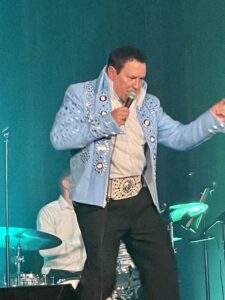
Wade Tower at the Constantine Theatre, Pawhuska, Oklahoma. Picture by Peg Redwine


Alright, I finally give it up; my 1950’s Saturday morning black and white Cowboy and Indian movies at the Kihekah Theater in Pawhuska, Oklahoma are truly gone. They have been blown away like a prairie tornado by the big band sounds of Wade Tower and his marvelous musicians. Ah well, since Pawhuska is the capital of the Osage Indian Nation, we were always ambivalent as to which side to root for anyway.

On Saturday, June 03, 2023 from three to five in the afternoon Wade and his players with the multiple octaves and complicated rhythms transformed my old Kihekah Theater to the renovated Constantine Theatre and transported the audience across the plains to a séance with Frank Sinatra and Elvis Presley. It was exciting and refreshing to experience music that did not repeat ad nauseum a single beat and three banging chords. Although Wade did manage to pay homage to his Oklahoma roots with a little George Strait. He also got the audience singing along and gyrating to Neil Diamond’s “Sweet Caroline”, although I suspect alcohol may have been sitting in as a contributor from the appreciative audience. Wade and his Blues Brothers-dressed band members filled the ornate and historic Constantine with the kind of music and talent the old venue has not seen since my brother, C.E. Redwine, reprised his Oklahoma State University Blue Note Band there in 1994 when the newly renovated Constantine was re-dedicated. In fact, Floyd Haynes, who is Wade’s bandleader, reminded me of C.E.’s Paul Desmond quality saxophone playing.

Wade Tower and his band. Picture by Peg Redwine

Each of Wade’s ensemble was terrific. Wade’s vocals were powerful, sensitive and truly enjoyable. Sean Johnson on the tenor sax, Zac Lee sliding the trombone, Ryan Sharp on the trumpet, Chase Gulliver on drums, Vince Norman, keyboard, Rod Clark, bass and the justly featured Jerry Connel on lead guitar were solo quality artists. It was so exhilarating to feel each solid note and each changing key and modified rhythm. I like country music, but there are reasons there are seven notes with wonderfully complex sharps and flats as possibilities and multiple key signatures along with intricate tempos. Thank you Wade and your band for knowing and applying the full range of them. And further kudos go to the light and sound technicians who did a terrific job helping to bring Vegas to Pawhuska.

Also, thank you to the Board of the Constantine Theatre for your foresight and good taste in contracting with Wade Tower to perform every Saturday at 3:00 p.m. up to December 2023. Peg and I are eagerly looking forward to enjoying Las Vegas in the Osage again.
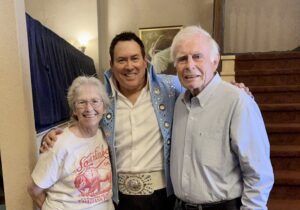

Peg Redwine, Wade Tower & Jim Redwine at the Constantine Theatre, Pawhuska, Oklahoma

Share this:

  • Share on Facebook (Opens in new window) Facebook
  • Share on X (Opens in new window) X
  • Email a link to a friend (Opens in new window) Email
  • Share on WhatsApp (Opens in new window) WhatsApp

Like this:

Like Loading...

Filed Under: Events, Gavel Gamut, Oklahoma, Oklahoma State University, Osage County, Pawhuska Tagged With: big band sounds, C.E. Redwine, Chase Gulliver, Constantine Theatre, Elvis Presley, Floyd Haynes, Frank Sinatra, James M. Redwine, Jerry Connel, Jim Redwine, Kihekah Theater, Las Vegas, Oklahoma, Pawhuska, Road Clark, Ryan Sharp, Sean Johnson, The Osage, Vince Norman, Wade Towers, Zac Lee

The American Mantra

March 6, 2023 by Peg Leave a Comment


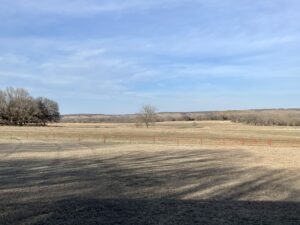
From “The Veranda” @ JPeg Osage Ranch. Photo by Peg Redwine

Peg and I got back to “The Osage”, Osage County, Oklahoma, USA on 26 February 2023 after a trip of two days from the one-time Soviet Union Republic of Georgia that is bordered by Russia and Turkey and lies directly across the Black Sea from Ukraine, that, also, was a former member of the Soviet Union. Georgia has a population of about four million, almost every one of whom we met yearned to come to the USA and every one of whom was insatiably curious about, “What makes America, America.” The Georgian judges we worked with from June 2022 to April 2023 unfailingly asked me “How do American judges do …?”

I was sent to Georgia by the United States Agency for International Development, the American Bar Association and the East-West Management Institute because I have been on the faculty of the National Judicial College (NJC) since 1995 teaching other judges from the United States and several foreign countries. I have designed and taught courses on judging to judges, lawyers and court administrators from Palestine (1996), in Ukraine (1999-2000), in Russia (2003) and in Georgia (2022-2023) as well as judges from other countries when they attend courses at the NJC.

My unsurprising conclusion from ten years of practicing law and forty-three years of judging is lawyers and judges and the citizens who must look to us for justice are pretty much the same everywhere. Most people are good most of the time, most people are bad some of the time and everyone everywhere wants to know why the USA is a beacon to the world. That is what I have been asked to report on during a series of debriefings concerning our mission to Georgia.

In other words, even we Americans spend a great deal of time cogitating on what makes American judges different from foreign judges. I have certainly invested a lot of years in this quest and today during a Zoom meeting with experts from Georgia and America I plan to offer my analysis. For such a complex and important subject my thoughts synthesize to a rather pedestrian mantra:

With all the judiciaries from other countries it has been my pleasure and privilege to know and work with, my perception is they believe that unless there is a specific, written law that authorizes them to take a particular action, even if they know it is the right and just thing to do, they cannot ethically and legally do so and, therefore, they refuse to act.

Whereas judges from the United States believe that unless there is a specific, written law that prohibits the judge from taking a bold, just and fair action in a case, the judge will take the action even if there is no law that specifically allows it.

This mantra is deep within America’s judicial psyche. Some, when they disagree with a judge’s imaginative decision, might criticize it as “judicial activism”. Of course, when they agree with the decision, they call it “wisdom”. But if one wants to define the bright-line difference in what other countries yearn for and what America’s judges are admired for it is just this, Judicial Independence!

This general philosophy falls within what that great American dreamer Robert Kennedy called his mantra:

“Some people see things as they are and ask, Why? I see things as they should be and ask, Why not?”

So, after 8 months of responding to my Georgian friends’ incessant curiosity of what makes America and its legal system the hope of many other countries, I point out it is not for nothing the most recognized symbol of America is The Statue of LIBERTY (that is, the freedom to do the right thing)!

Share this:

  • Share on Facebook (Opens in new window) Facebook
  • Share on X (Opens in new window) X
  • Email a link to a friend (Opens in new window) Email
  • Share on WhatsApp (Opens in new window) WhatsApp

Like this:

Like Loading...

Filed Under: America, Democracy, Gavel Gamut, Judicial Tagged With: American judges, Black Sea, Bobby Kennedy, EWMI, foreign judges, freedom, Georgia, James M. Redwine, Jim Redwine, NJC, Peg, Russia, Soviet Union, Statue of Liberty, The American Mantra, The Osage, Turkey, Ukraine, USA, USAID, Zoom meeting

© 2026 James M. Redwine


Loading Comments...
 

    %d