• Skip to primary navigation
  • Skip to main content

James M. Redwine

  • Books
  • Columns
  • 1878 Lynchings/Pogrom
  • Events
  • About

John Donne

Those People

October 1, 2026 by Peg Leave a Comment

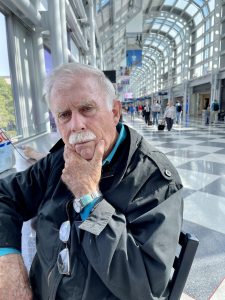
Photo by Peg Redwine 

Joseph Campbell (1904-1987) was a philosopher whose main concentration was comparative mythology. As we look to Campbell for guidance on war and peace, Gentle Reader, you might want to remember I am to understanding Campbell as a reporter is to understanding Artificial Intelligence. The same sort of puzzlement you may experience after reading my analysis of Campbell’s recitation of the age-old mythology of war is what I feel when a reporter with a degree in English stumbles around A.I. with Geoffrey Hinton. In other words, one would be prudent to rely on their own conclusions rather than to simply elide over mine when Campbell’s higher thoughts are an issue. With that product warning, let’s dive in.

Campbell wrote many books on mythology. One of my favorites is Myths to Live By. It is only 276 pages long. However, if you are like me, it will take you as long to digest it as it would James Joyce’s Ulysses. On the other hand, Myths to Live By is much more useful and interesting than Ulysses and, frankly, easier to understand.

In Campbell’s chapter on the “Mythologies of War and Peace” Campbell sets forth his central thesis as follows:

“For it is a basic idea of practically every war mythology that the enemy is a monster and that in killing him one is protecting the only truly valuable order of human life on earth, which is that, of course, of one’s own people.”

Campbell juxtaposes this philosophy with that of the great German philosopher Arthur Schopenhauer (1788-1860). Campbell cites to Schopenhauer’s essay “The Foundation of Morality” in which Schopenhauer asks:

“How is it that an individual can so forget himself and his own safety that he will put himself and his life in jeopardy to save another from death or pain – as though that other’s life were his own, that other’s danger his own? Such a one is then acting out of an instructive recognition of the truth that he and that other in fact are one.”

Campbell says such actions occur because we occasionally recognize that we are all one. Such actions are motivated by the one and only inspiration of inherently moral action. For a moment one is selfless, boundless, without ego.

This epiphany that we are all one is what Jesus was preaching about. Or as John Donne (1572-1631) put it in his poem, For Whom the Bell Tolls:

“No man is an island, entire of itself; … any man’s death diminishes me, because I am involved in mankind.”

So, the mythology of war is mainly between all “others” are monsters versus there are no “others” because we are all one. We must strive to defend ourselves and our fellow citizens from those “others” when they regard us as “the other”, but we will only achieve true peace when we and all “others” accept that we are one. While some defensive wars are still necessary for our survival, if we are to avoid extinguishing our species, we must accept all as we want them to accept us.

At least that’s what I got from Professor Campbell or I might have learned it by being horrified by the news. Of course, my wife Peg points out that other fine contemporary philosopher, John Lennon (1940-1980), said the same things in his song, Imagine. And it certainly is easier on the brain.

You can also follow us on Facebook at “Jim Peg Redwine” or Substack “@gavelgamut”

Share this:

  • Share on Facebook (Opens in new window) Facebook
  • Share on X (Opens in new window) X
  • Email a link to a friend (Opens in new window) Email
  • Share on WhatsApp (Opens in new window) WhatsApp

Like this:

Like Loading…

Filed Under: Authors, Gavel Gamut Tagged With: Arthur Schopenhauer, Artificial Intelligence, Gentle Reader, Geoffrey Hinton, James Joyce, James M. Redwine, Jim Redwine, John Donne, John Lennon, Joseph Campbell, war and peace, we are one

It Is A Marathon

April 10, 2020 by Peg Leave a Comment

Modern Americans have been blessed by the sacrifices of many before us. We can hope each person who gave their lives in service to America believed the Roman poet Horace (65 BCE-08 BCE) was correct: Est dulce et decor pro patria morte.

One of those previous Americans to whom we owe a debt of gratitude was John Kennedy (1917-1963). Kennedy was injured in battle in World War II and suffered severe back pain because of it. As a young man he sat in a rocking chair to ease his pain. Yet Kennedy did not take the position America owed him anything. In his presidential inaugural address of January 20, 1961 he exhorted us to ask not what our country can do for us but what we can do for our country.

And as the English poet John Donne (1572-1631) advised, when one hears a bell tolling because someone has died, it tolls for each of us because we are all involved in mankind. As Donne observed, each person’s death diminishes us all.

Our current conflict pits all of us against a frightening enemy. It is COVID-19 against us all much as our country has been attacked many times before. Previous Americans have had to make similar difficult sacrifices. Through no one’s fault, including our own, it is now our time to face tough choices. My experiences with Americans and a reading of our country’s history convinces me that we are up to the challenge.

Oh, I am aware we could ignore the virus and it would eventually die out as we develop natural anti-bodies to it. We might lose a couple of million people from COVID-19 and then millions more later as COVID-19 becomes COVID-20, 21, etc., as it mutates. But chances are most of our country’s 330 million people would survive, the economy would recover quickly and as the folk singer Phil Ochs (1940-1976) wrote, probably hardly anyone would long notice, “.. outside of a small circle of friends”. Fortunately, most Americans see their duty to their country more as recommended by President Kennedy.

However, it is not easy. A great many people have had important matters in their lives simply devastated by the enemy and our collective response to it. Weddings, funerals, religious services, life savings, graduations and countless other vital and important matters have been ravaged by something completely beyond the affected people’s control and something for which they bear no blame. We should recognize these sacrifices just as we know we have been blessed by the selflessness of previous Americans. But with a steadfast resoluteness we can weather this storm by applying proven guidelines until we defeat this scourge, which we most certainly will do within the next few months.

We are in a Marathon. It started out as a battle against a fierce enemy from Asia much as the ancient Greeks faced when the Persians attacked. We are now well on the way to victory. It is no longer more than twenty-six miles. Athens is in sight but we must stay the course for awhile longer. Pheidippides made it the whole way in 490 BCE and so can we.

Share this:

  • Share on Facebook (Opens in new window) Facebook
  • Share on X (Opens in new window) X
  • Email a link to a friend (Opens in new window) Email
  • Share on WhatsApp (Opens in new window) WhatsApp

Like this:

Like Loading…

Filed Under: America, COVID-19, Events, Gavel Gamut, Patriotism Tagged With: ancient Greeks, Asia, Athens, COVID-19, fierce enemy, Horace, James M. Redwine, Jim Redwine, John Donne, John Kennedy, Marathon, Persians, Pheidippides, Phil Ochs, resoluteness, sacrifice, selflessness

© 2026 James M. Redwine

Loading Comments...
%d