
• Skip to primary navigation
  • Skip to main content

James M. Redwine

  • Books
  • Columns
  • 1878 Lynchings/Pogrom
  • Events
  • About

Barack Obama

Undermining the Courts

April 20, 2023 by Peg Leave a Comment

At 3:30 am on Thursday, April 20, 2023 I was watching cable news anchor Alex Wagner of MSNBC, who was analyzing the controversy involving two conflicting federal court rulings concerning the abortion drug Mifepristone. Wagner pointed out the federal district judge in Texas had been appointed by President Donald Trump. Ms. Wagner did not refer to the federal district judge in the state of Washington having been appointed by President Barack Obama. Wagner opined that these diametrically opposed court holdings and the U.S. Supreme Court’s attempts to reconcile them, “Could undermine the legitimacy of the courts.”

Naturally, Gentle Reader, your first thought is what was I doing watching television at three thirty in the morning and why would I watch MSNBC at any time? As to why I was awake, hey, I’m frequently responding to urges I never had when life was new. As to why MSNBC, I watch the news with my finger on the remote so I can attempt to outmaneuver the commercials. MSNBC happened to have the court story on instead of some offer of products guaranteed to enhance weight loss and other things, so I listened in.

It was Wagner’s views on the court system, not any exposition of Mifepristone, that piqued my attention. She said on national TV what may be a sub rosa thought with many Americans, “Why should we have confidence in the independence and reliability of our federal judges?” Are federal judges acting as Socrates demanded or are they deciding cases politically? Does a federal judge’s ruling depend more on the facts and the law or the judge’s political views and those of the president who appointed them?

In his trial before the Athenian judges, Socrates admonished his judges, “To do justice, not make a present of it.” In other words, a judge’s duty is not to repay his or her appointing politician, but:

“To hear courteously; to answer wisely; to consider soberly; and to decide impartially.”

Americans have for over 200 years supported the right of judges to be a separate and independent branch of our government. However, in our current national environment, many decisions from, especially the U.S. Supreme court, but more and more frequently also from the lower federal courts due to wide-ranging injunctions from one-person federal district judgeships, are seen by many Americans as political pronouncements.

Virtually every national debate about federal judicial decisions begins with a reference to the politics of who appointed the judge or judges and the history of the judge’s political leanings. It may be difficult to recall, but before our current turbulent social environment seldom was it alleged that, as justices Stephen Breyer, Elena Kagan and Sonia Sotomayor said in dissent to the abortion decision of Dobbs vs. Jackson, “Today the proclivities of individuals (Supreme Court Justices) rule.”
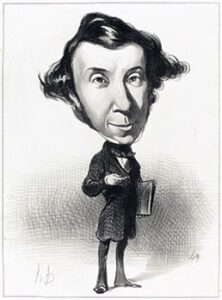
When even one third of the members of the U.S. Supreme Court publicly and in print accuse the other two thirds members of deciding cases for political reasons, it sounds an alarm about an independent judiciary. An independent judiciary is essential to maintaining our democracy. As long ago as 1835 Alexis de Tocqueville noted, “In America, practically every political question eventually becomes a judicial one.” De Tocqueville meant that Americans have confidence in the impartiality of our courts so they take their disputes to courts to be resolved.

It would be a shame if now de Tocqueville might have to conclude, “In America, practically every federal judicial question becomes a political one.” Perhaps next week, if I am still awake at 3:30 am, we might further address these volatile issues including some suggested remedies.

Share this:

  • Share on Facebook (Opens in new window) Facebook
  • Share on X (Opens in new window) X
  • Email a link to a friend (Opens in new window) Email
  • Share on WhatsApp (Opens in new window) WhatsApp

Like this:

Like Loading…

Filed Under: America, Democracy, Gavel Gamut, Judicial, News Media Tagged With: Alex Wagner, Alexis de Tocqueville, Barack Obama, Dobbs vs. Jackson, Donald Trump, federal judges, Gentle Reader, independence of the Judiciary, James M. Redwine, Jim Redwine, Mifepristone, MSNBC, Socrates, U.S. Supreme Court, undermining the courts

The First Casualty

January 17, 2020 by Peg Leave a Comment

When our son, Jim, served in the Gulf War in 1990-91 and the Iraq War in 2006-07 and briefly in the Afghanistan War in 2007 he observed one of war’s most vital premises: our country should never fall behind the curve of military superiority. America was fortunate to recover from Pearl Harbor in time to help the Allies survive World War II. In the age of nuclear and cyber warfare we might not be able to survive World War III with outdated technology. The United States must remain vigilant. Vigilance does not call for aggression. In fact, our Constitution demands defense, not offense. However, we have been in an offensive mode militarily since we unwisely intervened in Viet Nam after France was driven out in 1954 after the Battle of Dien Bien Phu. Beginning in 1956 America saw fit to emulate the errors of the French and we have been intervening militarily in numerous countries ever since.

One thing we Americans thought we had learned from the discovery that our government had misled us into the Viet Nam War was the old truism that in war the first casualty is truth. This adage is often attributed to Aeschylus (525-456 BCE) but it probably has been noted by many observers of peoples drawn into wars by their leaders. By the way, those leaders have almost always not been the ones to do the fighting.

Such examples as King David sending Uriah to die in battle to hide David’s seduction of Uriah’s wife, Bathsheba, Second Samuel, chapter 11, or perhaps President George W. Bush’s false claim that Iraq had weapons of mass destruction or now our government’s claims about our war in Afghanistan may illustrate this ancient principle.

Just this month Special Inspector General for Afghanistan Reconstruction John Sopko testified before the House of Representatives Foreign Affairs Committee that America’s war in Afghanistan, our longest war ever, was conducted on a basis of lies to get and maintain Congressional political and funding support. The Washington Post newspaper published reports that Douglas Lute, former White House Afghan War official under both President George W. Bush and President Barack Obama, had testified America invaded Afghanistan in 2001 without a fundamental understanding of Afghanistan or what America planned to accomplish there.

Of course, Americans are no longer surprised that our government misleads us into wars. Unfortunately we have become inured to it. That is the danger. It is as frightening as the old story of the boy who cried wolf. If our government continues to mislead us into unnecessary wars, will we citizens respond appropriately when, and it could happen some day, we are asked to sacrifice our lives and treasure for a just cause such as our country’s survival?

Share this:

  • Share on Facebook (Opens in new window) Facebook
  • Share on X (Opens in new window) X
  • Email a link to a friend (Opens in new window) Email
  • Share on WhatsApp (Opens in new window) WhatsApp

Like this:

Like Loading…

Filed Under: Foreign Intervention, Gavel Gamut, Middle East, War Tagged With: Aeschylus, Afghanistan War, Barack Obama, Bathsheba, Battle of Dien Bien Phu, Douglas Lute, George W. Bush, Gulf War, Iraq War, James M. Redwine, Jim Redwine, John Sopko, King David, our government has misled us into unnecessary wars, the first casualty of war is truth, the story of the boy who cried wolf, Uriah, Viet Nam War, Washington Post, Weapons of Mass Destruction, World War II, World War III

© 2026 James M. Redwine

Loading Comments...

    %d