• Skip to primary navigation
  • Skip to main content

James M. Redwine

  • Books
  • Columns
  • 1878 Lynchings/Pogrom
  • Events
  • About

Confederate

The Battle of Honey Springs

July 23, 2025 by Peg Leave a Comment

In the Honey Springs Battlefield Gift Shop. Photo taken by Peg Redwine

Just as my public-school education failed to lead one to analogies involving America’s Manifest Destiny and slavery or the genocide of indigenous peoples, it often concentrated on the perceived benefits bestowed on both Negroes and first Americans by their white governors. Black and Indian contributions to our shared history were generally omitted or diminished. My knowledge of these significant influences on America’s unrelenting march from the Atlantic to the Pacific and from Canada to the Gulf of Mexico came mostly by coincidence. Such was the case when Peg and I heard about the Civil War Battle of Honey Springs.

Our first exposure to this most important Civil War conflict in Indian Territory came from a brief mention of it on PBS just this past spring. We researched it, on the Internet of course, and discovered it occurred July 17, 1863 near Checotah, Oklahoma which is only about an hour and a half from our home in Osage County, Oklahoma. It was readily apparent why this “Gettysburg of the West” is barely a blip in our nation’s consciousness. Although the battle determined whether the Union or Confederate forces would control the vital Texas Road that protected supply lines from Mexico to Kansas right through the heart of Indian Territory (Oklahoma), the soldiers who fought the desperate fight consisted of white, Black and several tribes of Native Americans who supported both sides.

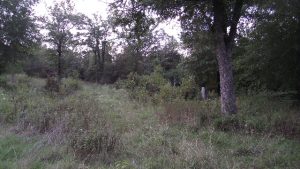
Photo by Peg Redwine.

In fact, the 1st Kansas Colored Infantry was instrumental in the battle for the Union and several Black soldiers fought alongside Creek, Choctaw, Cherokee, Seminole and Chickasaw warriors who had divided loyalties for both the North and the South. The commander of the 1st Kansas Colored Infantry was the only white man for that brigade.

Honey Springs, the location of this battle involving several thousand soldiers for each side, was named for a gigantic beehive that was attached to a large oak tree near the running spring. As with much of military history the outcome of the battle hinged on the weather. The Southern forces were in that location because the commander of Southern Forces in the Indian Territory, Maj. Gen. William Steele, ordered the capture of fairly nearby Ft. Gibson. Steele dispatched troops under Brig. Gen. Douglas Cooper to meet up with other Confederate troops under the command of Gen. Cabell whose men were about 25 miles from Honey Springs. His soldiers did a forced march through rain, mud and swollen streams but arrived late to the battle between Cooper’s and Union Gen. James G. Blunt’s soldiers. The fight was already a Union victory and the Texas Road as well as Ft. Gibson remained in Union control throughout the remainder of the Civil War.

Photo by Peg Redwine.

History may normally be written by the victors but America’s history has usually been written by white people east of the Mississippi River. Such is the case of Honey Springs. Some Civil War analysts posit this battle crippled any chance the Confederacy could recover from U.S. Grant’s victorious siege of Vicksburg, Mississippi that caused Southern Gen. John Pemberton to surrender to Grant on July 04, 1863, two weeks before the Union victory at Honey Springs.

Vicksburg secured Union control of the Mississippi River and the South’s loss at Honey Springs prevented the South from circumventing the Mississippi via the Texas Road. Gen. Cooper blamed the loss on inferior gunpowder that the South had to purchase from Mexico. Also, the rain made the inferior powder even more defective.

But what I suggest I and other Americans should have learned is the service of Black and First American conflicting loyalties and the reasons for them. Also, it should be noted that the “Gettysburg of the West” was and is deserving of a place in our country’s Volksgeist. If you are prone to Civil War reenactments, Gentle Reader, the Battle of Honey Springs reenactment will take place after the intense Oklahoma July heat is more kind to woolen uniforms on November 8, 2025. You can find more information about the battle and the reenactment weekend activities online at www.okhistory.org.


Photo by Peg Redwine.

Share this:

  • Click to share on Facebook (Opens in new window) Facebook
  • Click to share on X (Opens in new window) X
  • Click to email a link to a friend (Opens in new window) Email
  • Click to share on WhatsApp (Opens in new window) WhatsApp

Like this:

Like Loading...

Filed Under: America, Events, Gavel Gamut, Manifest Destiny, Native Americans, Oklahoma, Slavery, War Tagged With: Blacks, Confederate, Gettysburg of the West, James M. Redwine, Jim Redwine, Native Americans, North, South, The Battle of Honey Springs, Union

Raise a Parting Glass

November 11, 2021 by Peg Leave a Comment

Old Baptist Cemetery, Wilburton, Oklahoma

The old Irish folk ballad, “The Parting Glass”, is a favorite Irish drinking song and is almost always sung, often a cappella, to help the dearly departed on their way. Military veterans are also frequently toasted to honor their service as glasses are raised and the ballad is sung. As you will see that tradition was carried from Ireland to America.

It is Veteran’s Day and as a veteran I have been thinking of all the service members, those who have served before and with me and those who are serving now. The United States Air Force was very good to me even though I gave little more than some of my time during a time my time was not otherwise of much value. While in the Air Force I was sent to Indiana University for one year to study a foreign language. Once honorably discharged I received four years of the G.I. Bill. I still receive VA health benefits. If a balance sheet were kept, I would be much more benefitted than contributing. Fortunately, no such accounting is made. So, thank you America.

And it is not just myself in my family who have been blessed to serve. Both of my brothers and my brother-in-law received honorable discharges and veteran’s benefits from the Army. Our father wanted to serve in World War II but a massive heart attack and his age caused Uncle Sam to say “no thanks.” In my immediate family our son, Jim, got his college education at West Point and now receives disability benefits due to physical health problems caused by his active-duty combat service on the front lines of both the Gulf War and the Iraq War. His son, Nick, our grandson, just graduated from Army Ranger School as Jim did about thirty years ago. Nick also got his college education via an R.O.T.C. scholarship thanks to the Army.

During WWII my mother’s three brothers and one of her sisters served as did my wife’s grandfather and two uncles. Each of these honorably serving family members received post-war benefits from a grateful nation. So, once again, thank you America.

Now going back another generation to my grandfather, Adolphus Cash Redwine, who was born in Georgia in 1848 before he moved to southeastern Oklahoma. With grandpa we find a murkier but perhaps more interesting veteran even if I am not sure which color uniform the Civil War era teenaged soldier wore. All I do know is that a few years ago my first cousin, Paul Redwine, who was the eldest son of one of my father’s numerous brothers living in the Wilburton, Oklahoma area told my sister, Janie, another of our uncles, Henry, received a letter of inquiry from the Veteran’s Administration in regard to our grandfather.

The letter stated grandfather’s military records indicated he was entitled to a military grave marker. Please remember this was at a time all service, Confederate or Yankee, was honored. The VA wanted someone to guide them to grandfather’s burial site. Paul said our Uncle Henry volunteered and the federal man showed up in Wilburton, Oklahoma with a bronze marker for grandpa’s grave.

Uncle Henry was one of the few people who knew the place where granddad was buried as grandfather was a Baptist minister who was preaching from the bed of a buckboard at a camp meeting in the remote hills of southeastern Oklahoma when something spooked the team of mules hitched to the buckboard. The mules took off and grandfather was thrown to the ground and killed. The congregation, at my grandmother’s request, buried grandpa right there with a board to mark the spot. That area grew into the tiny Bug Scuffle Cemetery outside Wilburton. Uncle Henry knew generally where the Bug Scuffle Cemetery was located among the sparsely populated hills. Unfortunately, Uncle Henry also happened to be a local source of moonshine. Uncle Henry made the gentlemanly suggestion that before he and the federal man placed the marker on grandfather’s grave, they should raise a toast in his honor using some of the family’s pride. The federal man, probably not wishing to offend, readily agreed.

My guess is grandfather’s military service, whatever it was, was still honorable even if his marker is not on his grave. For, as you see, Uncle Henry and the federal man raised so many parting Ball fruit jars to granddad’s service they never found his gravesite and lost the marker during their search. However, to grandfather and all veterans I am raising a metaphorical parting glass to say thank you and well done, and thank you to America for allowing us to serve.

Share this:

  • Click to share on Facebook (Opens in new window) Facebook
  • Click to share on X (Opens in new window) X
  • Click to email a link to a friend (Opens in new window) Email
  • Click to share on WhatsApp (Opens in new window) WhatsApp

Like this:

Like Loading...

Filed Under: America, Democracy, Events, Family, Funerals, Gavel Gamut, Military, Oklahoma, War Tagged With: Adolphus Cash Redwine, Air Force, America, Army, Ball fruit jar, Bug Scuffle Cemetery, Civil War, Confederate, G.I. Bill, Henry Redwine, Indiana University, Ireland, James M. Redwine, Jim Redwine, military veterans, moonshine, Paul Redwine, R.O.T.C., Ranger School, The Parting Glass, Uncle Sam, VA health benefits, Veteran's Day, Wilburton, World War II, Yankee

© 2026 James M. Redwine


Loading Comments...
 

    %d