• Skip to primary navigation
  • Skip to main content

James M. Redwine

  • Books
  • Columns
  • 1878 Lynchings/Pogrom
  • Events
  • About

Philip Redwine

We Weren’t Heavy

March 15, 2024 by Peg Leave a Comment

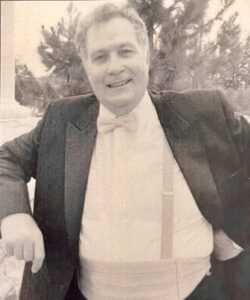
C.E. “Sonny” Redwine

My grandfather Redwine was born in 1848 in Walls, Georgia. After the Civil War he traveled to Indian Country, married and had five children. After his first wife died young, he married my grandmother who was a widow with six children. Together they had seven more children, of which my father was next to the youngest. My grandfather was a Baptist minister who may have known the Bible but unfortunately was careless in his choice of pulpits. He was preaching to a camp meeting while standing on a buckboard hitched to a skittish horse that got spooked by grandpa’s vociferous sermon. The horse bolted, grandpa lost his balance, fell off, hit his head and died. He was buried on the spot by grandmother and the congregation. My father was eleven years old and in the third grade when he and his numerous siblings were forced to raise themselves and one another while grandmother held the family together.

My father left school at age eleven and went to work in the high-sulfur unregulated coal mines of what by then was the southeastern corner of the new state of Oklahoma. Breathing in the coal dust led to my father’s massive heart attack at age thirty-three and to his ever-tenuous hold on his health until his death at age fifty-nine. Dad did not have the benefit of instruction from his father, but learned life’s lessons from his older brothers. This circle of concern and love helped make Dad a wonderful and kind father and also caused him to believe it was natural for one’s older brothers to educate them.

With my siblings and myself this meant my older sister, born in 1937, helped Mom with the household while my brother, Philip, born in 1942, and I born, in 1943, were mentored by our older brother, C.E. Redwine, born in 1936. C.E. (Sonny to the family) was our guide and protector. Sonny was the most patient and encouraging teacher and coach. He taught Phil and me to fish, play baseball and appreciate music. Mainly he taught us to be curious, strive to be our best and love every second of life.

Sonny was an inexhaustible deep well of knowledge and had the unselfish gift of generosity to share it. He could play and teach instrumental music and sing, teach and conduct choral ensembles. C.E. led our sister Jane and Phil and me in our church choir. He formed and performed with numerous dance bands. He played his brilliant saxophone all over the world with the United States Army Field Band. And everything he learned and experienced worked to the benefit of Janie, Phil and me as he always found the time and opportunity to share.

Sonny was a master chef and gardener. He knew how to grow food, when to harvest it and how to cook it, especially how to season it. He knew how to butcher every kind of meat and preserve it. My wife, Peg, and I must have gone to Sonny thousands of times for advice on every arcane topic one can imagine. He always knew what and how to do things and, most importantly, generously shared his knowledge without any hint of self-righteousness or impatience.

For all three of us, Janie, Phil and me, Sonny gladly sacrificed his time for our betterment. Our father and mother gave to us fully, but Sonny inspired us every day. I guess now our interests will begin to narrow and our questions will go unanswered.

Share this:

  • Click to share on Facebook (Opens in new window) Facebook
  • Click to share on X (Opens in new window) X
  • Click to email a link to a friend (Opens in new window) Email
  • Click to share on WhatsApp (Opens in new window) WhatsApp

Like this:

Like Loading...

Filed Under: Events, Family, Funerals, Gavel Gamut, Oklahoma, Pawhuska Tagged With: C.E. Redwine, inspiration, James M. Redwine, Janie, Jim Redwine, Philip Redwine, Sonny, United States Army Field Band, wealth of knowledge

Legally Thinking

May 29, 2020 by Peg 2 Comments

Mount Rushmore


My brother, Philip Redwine, that is Philip spelled with the Biblical one “l”, graduated from the Oklahoma University Law School while I was an undergraduate at Indiana University. When I asked him what he had been taught he told me the entire process boiled down to “learning to think like a lawyer”. When I excitedly quizzed him about that arcane and mysterious subject he replied the whole three years of law school could be summarized by the following story:

“A client asked his attorney for advice as to whether he should file for a divorce. The client told the attorney that each time he tried to climb the stairs to the second floor of the couple’s home his wife would kick him back down. The man said to the attorney, ‘Doesn’t that show she doesn’t love me anymore?’ The attorney reflected on the situation and thoughtfully responded, ‘Either that or she just doesn’t want you upstairs.’”

So, to think like a lawyer means to objectively consider a situation from all sides and apply any relevant analogies to it. After three years of my own legal education at Indiana University, then ten years practicing law and forty years of being a judge, my conclusion is my brother was right and that lawyer-type analysis requires imagination and objective open-mindedness. I respectfully suggest we may want to try this approach to our COVID-19 impacted situation as some of our greatest legally trained presidents might have done. Yes, we must act now but we should do so with wisdom, courage and imagination.

Vision and objectivity have certainly been displayed by several of our greatest non-legally trained presidents. George Washington and Theodore Roosevelt readily come to mind. However, I would like to discuss with you a few of our legally thinking leaders who helped guide us through tough times by having the ability to seize opportunity from crisis by winnowing the wheat from the chaff.

Thomas Jefferson saw the Louisiana Purchase of 1803 and the Lewis and Clark Expedition of 1803-1806 as a means of expanding the United States from the Atlantic to the Pacific and discovering the untold resources of our country. Jefferson did this at a time when most Americans still feared, or too much admired, Great Britain. And he had to maneuver the funding through a skeptical Congress.

The Golden Spike

Abraham Lincoln was faced with the possibility of California seceding from the Union and with slavery remaining as a state option even if the South were defeated. He boldly issued the Emancipation Proclamation in 1863 and that same year signed the bill funding the Intercontinental Railroad. Lincoln did not live to see the golden spike driven at Promontory, Utah on May 10, 1869, but his use of grants of public lands and issuance of bonds helped preserve the Union he so admired.

Franklin Roosevelt saw the need for a great infusion of public funds for the education and re-employment of our out-of-work Americans during the Great Depression. Thanks to his vision America was much better prepared to respond to Japan and Germany in World War II.

John Kennedy started us on the elliptical route to the moon as financed with public monies. The vast number of jobs, products and conveniences the Space Program brought are still being enjoyed by our citizens.

I do not cite these heroes’ legal training as required for a novel approach to the Novel Virus. Millions of Americans can see that borrowing trillions of dollars to help people for a short time merely delays the pain. A cure requires applying our resources with a long view. We can invest in ourselves for the future while helping those in need now.

Germany’s Autobahn

One need not be a lawyer to see an issue such as COVID-19 from all sides and apply similar solutions as were used in similar prior crises. President Eisenhower was a West Point trained soldier who planned the greatest military invasion in history and could envision the benefits from a German Autobahn-type interstate highway system for America. And my friend, Warren Batts, is not an attorney but a rock ’n roll musician who suggests we could build a national high speed railway passenger system utilizing the middle portion of our already existing interstate rights-of-way between the separated lanes of traffic.

What we need, from our lawyers and non-lawyers combined, is the vision to prepare for our new society as it will surely be transformed by the Corona Virus. We will be changed but we can transform not regress. New skills can be taught using public funds as we did with the Lewis and Clarke Expedition, the Transcontinental Railroad, the Civilian Conservation Corps and the Space Program.

I realize these are not new ideas. That is my legally thinking point. You, Gentle Reader, will surely have several similar suggestions of your own, which I encourage you to share.

Share this:

  • Click to share on Facebook (Opens in new window) Facebook
  • Click to share on X (Opens in new window) X
  • Click to email a link to a friend (Opens in new window) Email
  • Click to share on WhatsApp (Opens in new window) WhatsApp

Like this:

Like Loading...

Filed Under: America, COVID-19, Gavel Gamut, Indiana University, Law, Law School, Slavery, War Tagged With: Abraham Lincoln, Civilian Conservation Corps, Congress, Corona Virus, COVID-19vision, Emancipation Proclamation, Franklin Roosevelt, From the Atlantic to the Pacific, Gentle Reader, George Washington, German Autobahn, Germany, Great Britain, Great depression, imagination, Indiana University, Intercontinental Railroad, interstate highway system, James M. Redwine, Japan, Jim Redwine, John Kennedy, learning to think like a lawyer, legally thinking, legally trained, Lewis and Clark Expedition, Louisiana Purchase, national high speed railway passenger System, objective open-mindedness, objectivity, Oklahoma University Law School, Philip Redwine, President Eisenhower, slavery, Space Program, Theodore Roosevelt, Thomas Jefferson, Warren Batts, West Point, World War II

© 2025 James M. Redwine


Loading Comments...
 

    %d