• Skip to primary navigation
  • Skip to main content

James M. Redwine

  • Books
  • Columns
  • 1878 Lynchings/Pogrom
  • Events
  • About

Posey County lynchings of 1878

A Eulogy for the Victims of October 1878 Revisited

November 6, 2023 by Peg Leave a Comment

Photo by Peg Redwine

Since 1990 when German born American Ilse nee Dorsch Horachek made me aware of the tragedy of 1878, my wife Peg and I have researched, spoken, written and helped produce a short movie about those events. And in our historical novel, JUDGE LYNCH!, that we published in 2008 we called for a public monument to the victims to be erected on the southeast corner of the Posey County Courthouse campus where the bones of Daniel Harrison, Sr. may still be buried. Our principal focus has always been the injustice done to the victims and the shameful failings of our legal system. Finally, thanks mainly to teenager Sophie Kloppenburg with input from numerous others a memorial marker to the victims was erected on the campus of the Posey County Circuit Courthouse October 23, 2022. Sophie also organized a one-year commemoration that was held October 21, 2023 and asked Peg and me to participate. The following is the eulogy to the victims that was published in Gavel Gamut after the monument was dedicated in 2022.

EULOGY FOR THE VICTIMS OF OCTOBER 1878

BY

JUDGE JIM REDWINE

FIRST PUBLISHED THE WEEK OF OCTOBER 23, 2022

ACCORDING TO JOSEPH CAMPBELL, TO BE UNAWARE IS THE ULTIMATE SIN. FROM THE AUTUMN OF 1878 UNTIL TODAY, OCTOBER 23, 2022, IN SPITE OF NUMEROUS EFFORTS TO BRING THE CARNAGE TO LIGHT, MOST OF POSEY COUNTY, INDIANA STAYED WILLINGLY UNAWARE OF THE MEMORY OF THE SLAUGHTER OF DANIEL HARRISON, SR., THE BURNING ALIVE OF DANIEL HARRISON, JR., THE SHOOTING OF JOHN HARRISON, THE LYNCHING ON THE COURTHOUSE CAMPUS OF JIM GOOD, WILLIAM CHAMBERS, EDWARD WARNER AND JEFF HOPKINS AND THE POGROM THAT CAUSED ONE-HALF OF THE REMAINING NEGRO RESIDENTS OF POSEY COUNTY, INDIANA TO FLEE FOR THEIR LIVES.

THIS MEMORIAL RESTS WHERE LOCUST TREES ONCE BORE THE STRANGE BLACK FRUIT WITH ELONGATED TONGUES, BULGING EYES AND NUMEROUS BULLET HOLES FROM THE GUNS OF WHITE CITIZENS WHO USED THE BODIES FOR TARGET PRACTICE.

FINALLY, WE CAN DEDICATE CONCRETE ACKNOWLEDGEMENT OF THE WHITE CITIZENS’ ORCHESTRATED AND DISCIPLINED CAMPAIGN OF TERROR AGAINST THE BLACK COMMUNITY AND THE SHAMEFUL COWARDICE OF THE LEGAL SYSTEM AND THE NEWS MEDIA TO NOT ONLY CONDONE THE TERRORISM, BUT TO ACTIVELY HELP HIDE IT FROM HISTORY.

WE DO NOT CELEBRATE TODAY AND WE CANNOT ATONE FOR YESTERDAY. WE CAN, AND DO, ACKNOWLEDGE WRONGS LONG IGNORED AS WE GATHER ABOVE WHERE THE BONES OF DANIEL HARRISON, SR., MAY STILL LIE MOLDERING, AND WE CAN AND DO SAY TO ALL THOSE VICTIMS FROM OCTOBER, 1878, WE AS A COMMUNITY, FINALLY, ARE PUBLICLY AWARE.

Share this:

  • Click to share on Facebook (Opens in new window) Facebook
  • Click to share on X (Opens in new window) X
  • Click to email a link to a friend (Opens in new window) Email
  • Click to share on WhatsApp (Opens in new window) WhatsApp

Like this:

Like Loading...

Filed Under: Gavel Gamut, Posey County Lynchings Tagged With: James M. Redwine, Jim Redwine, Posey County lynchings of 1878, Posey County Pogrom of 1878

A Dark Pall Lifted

November 6, 2023 by Peg Leave a Comment

This past Saturday, October 21, 2023 Posey County, Indiana held a vigil to honor the memories of Daniel Harrison, Sr., Daniel Harrison, Jr. John Harrison, Jim Good, William Chambers, Jeff Hopkins and Edward Warner, all Black men who were murdered the week of October 12, 1878. The vigil began at 10:00 am Saturday morning at the Alexandrian Public Library in Mt. Vernon and concluded at the courthouse square that evening. The commemoration was organized by Mt. Vernon teenager Sophie Kloppenburg and, much as the lynchings themselves, was a public event.

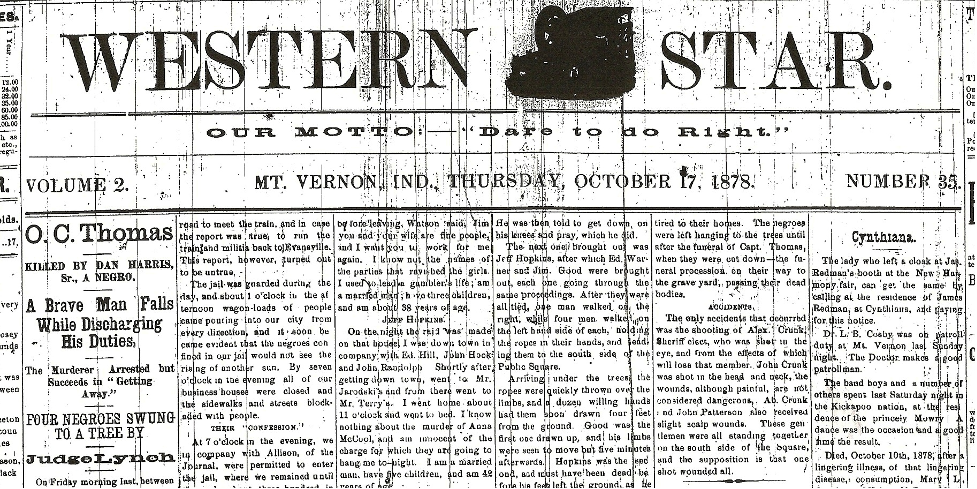
The underlying circumstances leading to the lynchings were set out on the front page of the October/November 1878 editions of Mt. Vernon’s Western Star newspaper. Owner and editor John Leffel was an eyewitness to the murders. The following account of the matter comes from editor Leffel and was first published in Gavel Gamut November 07, 2005:

“When ‘three white women living in a quiet and lonely part of Mt. Vernon’ claimed they had been raped by several African-American men on Monday, October 7, 1878, a Posey County Grand Jury quickly returned indictments against Daniel Harrison, Jr., John Harrison, Jim Good, Jeff Hopkins, Edward Warner, William Chambers, and Edward Hill.

On Tuesday, October 8, 1878, three white vigilantes took Daniel Harrison, Jr., from his father’s home and lynched him or threw him into the furnace of a railroad steam engine. On October 9, 1878, these same men returned to the Harrison home looking for John Harrison.  They put a revolver to Daniel Harrison, Sr.’s, head and threatened to kill him.  The men did not find John Harrison at the Harrison home, but did later dispose of him by putting his body into a hollow tree just east of Mt. Vernon.

 Four white lawmen went to the Harrison home at 2:00 o’clock a.m., on Thursday, October 10, 1878, to arrest Edward Hill, who was rumored to be hiding at the Harrison home.  At the time the lawmen arrived, Daniel Harrison, Sr., was home in bed, fully dressed and sleeping with a loaded shotgun due to the earlier instances at his home. During a melee at the home, Deputy Sheriff Cyrus O. Thomas was shot and killed, and Harrison, Sr., was charged with the shooting.   Harrison, Sr., who had been shot during the melee, turned himself in that same October 10th morning.  He was lodged in the Posey County Jail which was then located on the campus of our present courthouse. 

Also, Jeff Hopkins, Jim Good, Edward Warner, and William Chambers had been taken into custody and were incarcerated with Daniel Harrison, Sr., in the Posey County Jail.

On the front page of Posey County’s Western Star newspaper edition of October 10, 1878, editors, John C. Leffel and S.D. McReynolds, stated: 

“‘Jeff Hopkins, Jim Good,­ … and … other Negroes…forced an entrance into a house of ill-fame on First Street, Monday night, and raped the inmates there.  …Jim Good is not as good as his name, this being the second time he has been guilty of this crime.  …The girls raped were all white.  A little hanging would do Jim Good a great deal of good.’”  

Editor Leffel attended the jail break-in and the summary executions that took place two days after his article appeared.  Much of the information in this article came from his accounts. 

In the early morning hours of October 12, 1878, a mob broke into the jail, cut Daniel Harrison, Sr., into pieces and threw his body into the jail’s privy.  Jim Good, Jeff Hopkins, Edward Warner, and William Chambers were dragged out of the jail and hanged from the locust trees ringing the courthouse.  The four bodies were left hanging on the square until after the funeral of Cyrus O. Thomas, which took place the afternoon of October 12, 1878.

It was not unusual, especially in the south, for Negro lynch victims to be left hanging for an extended period of time as a “warning” to others who may have, also, “deserved hanging” but who had not been caught.

….

“By leaving the young men hanging on our public square all day, it would have been practically impossible for our law enforcement and judicial communities to be unaware of the lynchings.

However, even though the Posey County Prosecuting Attorney, the Judge and, in fact, most of Southern Indiana knew the men indicted for the rapes of the women and the murder of Officer Thomas had been killed in 1878, the legal system kept up a charade that the cases were going to be tried.  Every term of court from 1878 to 1881, the cases were called, then “set over to the next term.” 

During these three years, no action was taken against the people involved in the deaths of Daniel Harrison, Sr., Daniel Harrison, Jr., John Harrison, Jim Good, Jeff Hopkins, Edward Warner, and William Chambers.  In 1881, the Prosecutor, without fanfare, dismissed the indictments against the dead rape defendants.   I have not been able to determine the ultimate fate of Edward Hill [he may have escaped to Indian Territory]. 

This was not our legal system’s finest hour.  Of course, injustice is not the sole province of days gone by.  Today, “lynchings” are usually more procedural than literal and can involve letting the guilty go free as well as convicting the innocent.  Or they may involve imposing Draconian or effete punishment instead of justice.” 

As for now, the month of October has almost come and gone again and the spectres that have haunted my mind since first learning of these horrific events in 1990 are less demanding due to the erection of the memorial in 2022.


Share this:

  • Click to share on Facebook (Opens in new window) Facebook
  • Click to share on X (Opens in new window) X
  • Click to email a link to a friend (Opens in new window) Email
  • Click to share on WhatsApp (Opens in new window) WhatsApp

Like this:

Like Loading...

Filed Under: Authors, Events, Gavel Gamut, Posey County Lynchings Tagged With: James M. Redwine, Jim Redwine, Posey County lynchings of 1878, Posey County Pogrom of 1878

Reflections

December 10, 2018 by Peg Leave a Comment

Memorials take many forms and have many purposes. Some are large in scope covering acres of land containing statues and museums, such as Gettysburg Battlefield, or are smaller in area but allow visitors to absorb history and meaning through sober reflection, such as the Washita Battlefield National Historic Site where Custer ambushed and killed Chief Black Kettle, his wife and most of his tribe of peaceful Native Americans.

What should be the design of a Posey County’s memorial to the people and events of October 1878? Of course, that is a community decision best made by representatives of various interests. However, I respectfully suggest the purposes of a memorial should be the same regardless of the physical structure:

To honor the victims;

To recognize the events;

To learn from the past;

And to inspire a desire to make a better future.

When one visits Gettysburg the opportunity to simply walk The Wheatfield as did the Confederates, or crouch behind short stone walls awaiting the charge as did the Yankees is to be transported into the soul of the battle of July 1863.

At Washita, to silently walk the dirt paths the fleeing Indian families took on foot as Custer and his soldiers pursued them on horseback is to experience the horror of November 1868. No museum is necessary.

Whereas the design of a memorial to the events of October 1878 in Posey County should be the result of careful planning with input from numerous persons, the location should be pre-determined. It should be where the murders took place, which was on the campus of our beautiful and historic courthouse.

I respectfully suggest a small area on the southeast corner of the courthouse campus be set aside and that there be medium size stones or marble steles with the names of the victims along with small marble benches where people could sit and absorb the events of 1878 while reflecting on their meaning. Of course, there could be a brief explanation of the events on a historical marker that would match the overall design. However, the design is not as important as the statement we as a community should make by finally publicly recognizing the events.

Share this:

  • Click to share on Facebook (Opens in new window) Facebook
  • Click to share on X (Opens in new window) X
  • Click to email a link to a friend (Opens in new window) Email
  • Click to share on WhatsApp (Opens in new window) WhatsApp

Like this:

Like Loading...

Filed Under: America, Democracy, Events, Gavel Gamut, Posey County Lynchings, Slavery Tagged With: Chief Black Kettle, Custer, Gettysburg Battlefield, James M. Redwine, Jim Redwine, memorials, Posey County lynchings of 1878, reflections, Washita Battlefield National Historic Site

© 2026 James M. Redwine


Loading Comments...
 

    %d