• Skip to primary navigation
  • Skip to main content

James M. Redwine

  • Books
  • Columns
  • 1878 Lynchings/Pogrom
  • Events
  • About

Daniel Harrison Jr.

Positive or Negative

September 30, 2021 by Peg Leave a Comment

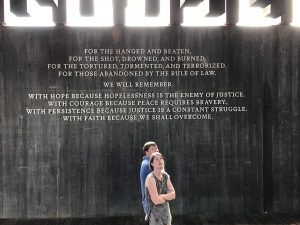
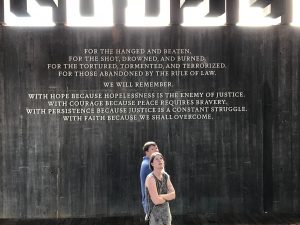
Equal Justice Initiative National Memorial Montgomery, Alabama


There is no memorial on the Posey County, Indiana courthouse lawn to the seven Negroes murdered by a white mob on October 12, 1878. There is a modest stele naming those soldiers with Posey County connections who served in   the Revolutionary War and an impressive statue honoring all who served in the Civil War. There are bronze plaques on the lobby walls of the Posey County Coliseum commemorating many of those who served. The Coliseum houses one of Posey County’s two courts and the other court is located in the courthouse.

Because I was the elected Posey Circuit Court Judge and because our son, James David Redwine, was a West Point graduate who would later earn a Bronze Star for Service on the front lines of both the Gulf War 1990-1991 and the Iraq War of 2003-2011 I was asked to speak at both the War Memorial Re-Dedication on Sunday, October 21, 1990 and Re-Dedication of the Soldiers and Sailors Monument on July 23, 2008. I was honored to do so and wrote the following poems for the occasions. The poems appeared in several newspapers after each commemoration:


WAR MEMORIAL RE-DEDICATION
(Sunday, October 21, 1990)

SUNDAY MORNING CHIMES

How dear it is to be alive:
To hear the peal of morning chimes;
To feel the invigorating sting of this autumn day;
To taste the rich and biting air;
To smell the acrid smoke of burning leaves;
To see the glory of Nature’s third act.

How satisfying to still be a player:
To know a child’s trust;
A family’s support;
A friend’s companionship; or
A lover’s caress.

How thrilling it is to learn,
To plan,
To strive
To serve,
To live!

These wondrous things:  These sensations;
These desires;
These dreams;
These visions.  This life,
Is what these heroes have sacrificed for us.

RE-DEDICATION OF THE SOLDIERS AND SAILORS MONUMENT
(Wednesday, July 23, 2008)

WELL DONE!

At Lexington and Concord, the young blood began to flow.
At the Battle of New Orleans, muskets killed our cousins and our foes.

At the Alamo and Buena Vista, we stood to the last man.
At Shiloh, Chickamauga and Gettysburg, brothers’ blood soaked the sand.

At San Juan Hill and when the Maine went down, our soldiers never flinched.
At Verdun and by the Marne, a million men died in the trench.

At D-Day and the Battle of the Bulge, after Hiroshima’s mushroom clouds,
At Incheon Landing the forgotten war brought many more funeral shrouds.

At Khe Sanh and during Tet, we held our own and more.
At the Battle of Medina Ridge, our Gulf War warriors upheld the Corps.

At Sinjar, Mosul, and places with strange names,
Our Iraqi War veterans now earn their fame.

In uniforms, our citizens have served well everyone.
Today, we here proclaim to them our solemn praise:  Well done!


It is fitting and proper that we honor those who serve and that we are permanently reminded of the horrors of war. Society needs to be constantly on guard and eternally grateful. Of course, the reasons that call for memorials about wars are much the same as why we need memorials to our collective evil done to some citizens by other citizens.

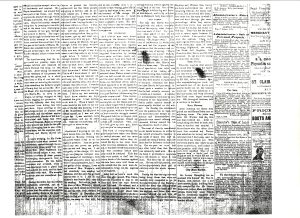
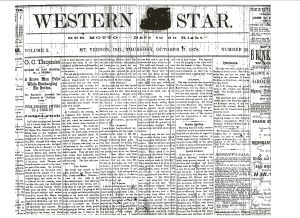
Since I first discovered, by accident, in 1990 the legal system’s long covered up murders of Daniel Harrison, Sr., Daniel Harrison, Jr., John Harrison, James Good, Ed Warner, William Chambers and Jeff Hopkins by, as the Mt. Vernon, Indiana Western Star Newspaper said on October 17, 1878, “two to three hundred of the county’s best white citizens” right on the Posey County, Indiana courthouse campus, I have called for accountability and a memorial to the victims. Society owes this atonement to the victims and we as a society need it for ourselves.
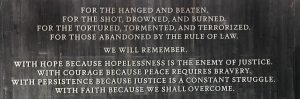
What the sign says. Pictures by Peg Redwine

Share this:

  • Click to share on Facebook (Opens in new window) Facebook
  • Click to share on X (Opens in new window) X
  • Click to email a link to a friend (Opens in new window) Email
  • Click to share on WhatsApp (Opens in new window) WhatsApp

Like this:

Like Loading...

Filed Under: America, Events, Gavel Gamut, Judicial, Law Enforcement, Military, Mt. Vernon, News Media, Posey County, Posey County Lynchings, War Tagged With: accountability, atonement, Bronze Star, Civil War, Daniel Harrison Jr., Daniel Harrison Sr., Ed Warner, Gulf War, Iraq War, James David Redwine, James Good, James M. Redwine, Jeff Hopkins, Jim Redwine, John Harrison, legal system's long covered up murders, lynchings, memorial to lynching victims, Mt. Vernon Western Star Newspaper, October 12 1878, Posey Circuit Court Judge, Posey County Coliseum and courthouse, Posey County Indiana courthouse lawn, Re-Dedication of Soldiers and Sailors Monument, Revolutionary War, War Memorial Re-Dedication, West Point, white mob, William Chambers

A Thousand Words

June 19, 2020 by Peg 2 Comments

I was born in Pawhuska, Osage County, Oklahoma where I spent my first 19 years (1943-1962). Osage County is adjacent to Tulsa and Tulsa County. The Tulsa race riots of 1921 were never mentioned during my 12 years of public education and one year at Oklahoma State University.

I served as a judge in Mt. Vernon, Posey County, Indiana from 1981-2018. Until March 14, 1990 the lynchings of African Americans that took place on the courthouse campus on October 12, 1878 were unknown to me and never brought to my attention.

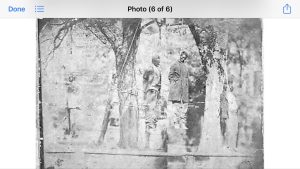
Upon being made aware of the Posey County murders I began to search for more complete information. A friend of mine, Glenn Curtis, who was born and raised in Posey County advised me he had seen a photograph of the 4 young Black men hanging from locust trees outside the courthouse door. He told me he remembered the elongated necks, swollen tongues and cue ball sized eyes of the hanging bodies. I have searched for a copy of that photograph since 1990.

October 12, 1878 Mt. Vernon, Indiana Courthouse Campus

My friend, Doug McFadden, who was also born and raised in rural Posey County told me that his grandfather told Doug that the day after the lynchings Doug’s grandfather watched as white citizens used the hanging young Black men for target practice. And while there was no photograph taken of the young Black man Daniel Harrison, Jr. who on October 10, 1878 was burned to death in the fire box of a locomotive in Mt. Vernon, another Posey County native friend of mine, Basil Stratton, told me that his grandfather, Walker Bennet, was an eyewitness. Walker told Basil that as a young boy he was present and saw several white men, including Walker’s father, force Harrison into the steam engine. Basil’s grandfather told Basil he never forgot the Black man’s screams and the smell of his burning flesh.

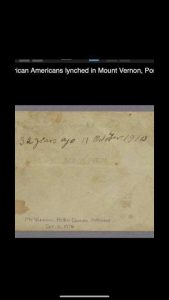
I have long thought that a photograph of the lynchings might be the evidence needed to finally get a memorial to the victims erected on the Posey County Courthouse campus. And yesterday my friends, Liz and Jeff Miller of Posey County, emailed me a copy of just such a photograph. Jeff and Liz received the copy from our mutual friend and historian, Ray Kessler of Mt. Vernon. Ray told me when we spoke by phone last night that he got the photograph from Karen McBride Christensen of Indianapolis who retrieved the picture from Georgia’s Emory University archives. I do not, as yet, know how it came to be there. Because of its graphic nature I have not attached it to this newspaper article. However, it did call me to reprise an article on race relations I first published July 4, 2005. Gentle Reader, as recent events may lead one to conclude the issues discussed in that article remain raw in our national psyche today, I offer it once more for your consideration.


HAPPY BIRTHDAY TO U.S.!

LET’S HAVE A PARTY AND INVITE EVERYONE!

(Week of July 4, 2005)

The United States Supreme Court has occasionally succumbed to popular opinion then later attempted to atone for it.  The Dred Scott (1857) and Plessy v. Ferguson (1892) cases come to mind as examples of institutionalized injustice with the partial remedy of Brown v. Board of Education (1954) being administered many years later.

In Dred Scott, the U.S. Supreme Court decided that American Negroes had no rights which the law was bound to protect as they were non-persons under the U.S. Constitution.

And in Plessy, the Court held that Mr. Plessy could not legally ride in a “whites only” railroad car.  The Court declared that laws that merely create distinctions but not unequal treatment based on race were constitutional.  SEPARATE BUT EQUAL was born.

Our original U.S. Constitution of 1787 disenfranchised women, and recognized only three-fifths of every Black and Native American person, and even that was only for census purposes.  Our Indiana Constitution of 1852 discouraged Negro migration to our state in spite of Posey County Constitutional Convention Delegate, Robert Dale Owen’s, eloquent pleas for fair treatment for all.

Were these documents penned by evil men?  I think not.  They were the result of that omnipotent god of politics, compromise, which is often good, but sometimes is not.  Should you have read this column recently you may recall that I strongly encourage compromise in court, in appropriate cases.

However, as one who grew up in a state where the compromise of the post Civil War judges and politicians led to the legal segregation of schools, restaurants, and public transportation, I can attest that some compromises simply foist the sins of the deal makers onto future generations.

When I was 6 years old, my 7 year old brother, Philip, and I made our first bus trip to our father’s family in southern Oklahoma.

We lived on the Osage Indian Nation in northeastern Oklahoma.  It sounds exotic but our hometown, Pawhuska, looked a lot like any town in Posey County.

In 1950 our parents did not have to worry about sending their children off with strangers except to admonish us not to bother anyone and to always mind our elders.

When mom and dad took us to the MKT&O (Missouri, Kansas, Texas and Oklahoma) bus station it was hot that July day.  Oklahoma in July is like southern Indiana in July, WITHOUT THE SHADE TREES!

My brother and I were thirsty so we raced to the two porcelain water fountains in the shot gun building that was about 40 feet from north to south and 10 feet from east to west.

Phil slid hard on the linoleum floor and beat me to the nearest fountain.  And while I didn’t like losing the contest, since the other fountain was right next to the first one, I stepped to it.

“Jimmy, wait ‘til your brother is finished.  James Marion! I said wait!”  Dad, of course, said nothing. He didn’t need to; we knew that whatever mom said was the law.

 “Mom, I’m thirsty.  Why can’t I get a drink from this one?”

 “Son, look at that sign.  It says ‘colored’.  Philip, quit just hanging on that fountain; let your brother up there.”

Of course, the next thing I wanted to do was use the restroom so I turned towards the four that were crammed into the space for one:  “White Men”, “White Ladies”, “Colored Men”, and “Colored Women”.

After mom inspected us and slicked down my cowlick again, we got on the bus and I “took off a kiting” to the very back.

I beat Phil, but there was a man already sitting on the only bench seat.  I really wanted to lie down on that seat but the man told me I had to go back up front.  And as he was an adult, I followed his instructions.

Philip said, “You can’t sit back there.  That’s for coloreds.  That’s why that colored man said for you to go up front.”

That was the first time I noticed the man was different.  That was, also, the point where the sadness in his eyes and restrained anger in his voice crept into my awareness.

As a friend of mine sometimes says, “No big difference, no big difference, big difference.”

And if all this seems as though it comes from a country far far away and long long ago, Posey County segregated its Black and White school children for almost 100 years after 600,000 men died in the Civil War.  In fact, some of Mt. Vernon’s schools were not fully integrated until after Brown was decided in 1954.

And, whether we have learned from our history or are simply repeating it may depend upon whom we ask.  Our Arab American, Muslim, Black, Native American, and Hispanic citizens, as well as several other “usual suspects”, may think the past is merely prologue.

Sometimes it helps for me to remember what this 4th of July thing is really about.  It’s our country’s birthday party; maybe we should invite everyone.

There is nothing equal about separate.

Share this:

  • Click to share on Facebook (Opens in new window) Facebook
  • Click to share on X (Opens in new window) X
  • Click to email a link to a friend (Opens in new window) Email
  • Click to share on WhatsApp (Opens in new window) WhatsApp

Like this:

Like Loading...

Filed Under: America, COVID-19, Democracy, Events, Gavel Gamut, Law Enforcement, Mt. Vernon, Oklahoma, Osage County, Posey County, Posey County Lynchings, Prejudice, Slavery Tagged With: 4 Black men hanging from locust trees, Basil Stratton, Brown v. Board of Education, Daniel Harrison Jr., Doug McFadden, Dred Scott, Gentle Reader, Glenn Curtis, Indiana, James M. Redwine, Jim Redwine, Karen McBride Christensen, Liz & Jeff Miller, lynchings, Mt. Vernon, Oklahoma, Osage County, Pawhuska, Plessy v. Ferguson, Posey County, Ray Kessler, Robert Dale Owen, Separate but Equal, the usual suspects, there is nothing equal about separate, Tulsa race riots, Walker Bennet

Why?

December 3, 2018 by Peg Leave a Comment

There were telephone calls, personal inquiries and Facebook posts. Thank you everyone! It speaks well for Posey County that people today are taking an interest in recognizing a terrible injustice that previous Posey County citizens committed and perpetuated by silence over one hundred years ago.

I have been a citizen of this fair county since 1976 and have been deeply involved in our legal system. From 1976-79 I served as the Chief Deputy Prosecuting Attorney, from 1979-80 as County Attorney to the Board of Commissioners, from 1976-81 as a practicing attorney, from 1981-83 as judge in what was then the Posey County Court (now the Posey Superior Court) and from 1983 to 2019 as the Posey Circuit Court Judge. And while I will retire as a full-time judge December 31, 2018, the Indiana Supreme Court has appointed me as a Senior Judge for 2019. In other words, I have had and have some responsibility for aiding in the administration of justice in Posey County.

Therefore, I believe it is my duty to help seek justice, at least in memory, for the seven men who were murdered during one week in October 1878. The murderers included two hundred white Posey County men who were aided by the silent complicity of the rest of our citizens. Since I first found out about these murders I have spoken and written about the events. The following is the Preface of my historical novel JUDGE LYNCH! that was published in July 2008.

PREFACE

On March 14, 1990, I spoke to the Posey County Coterie Literary Society in the courtroom of the Posey Circuit Court in Mt. Vernon, Indiana. As a thank you, the Society presented me with William P. Leonard’s History and Directory of Posey County (1882). The presentation was made by the Society’s President, Ilse Horacek. I read the book the following weekend and was struck by three brief paragraphs found at page 101:

“Annie McCool, a white prostitute, was murdered at Mt. Vernon, by some unknown person, in September, 1878. Her murderer was supposed to have been a negro paramour.

Daniel Harris, a negro, on October 11, 1878, shot and killed Cyrus Oscar Thomas, a son of Geo. W. Thomas, Esq., of Mt. Vernon, while the latter was in discharge of his duty as Deputy Sheriff. Harris was indicted by the grand jury at the October term of the Circuit Court in 1878, and at the August term of that court in 1881, the prosecutor, William H. Gudgel, entered a nolle prosequi. It is supposed by some and denied by others that Harris was murdered by the friends of his victim who disposed of his body by means which will forever leave its whereabouts a mystery.

James Good, Jeff Hopkins, Wm. Chambers and Edward Warner, all colored, were hanged October 12, 1878, by a body of unknown men, from trees in the Public Square, at Mt. Vernon for murders and other heinous acts committed by them during that year.”

I could not find any further description of these events that had occurred right outside my court chambers so I contacted Ilse who brought me a copy of the Western Star newspaper of October 17, 1878, that she had pieced together from the microfilm records stored at the Alexandrian Public Library in Mt. Vernon.

As a German child during World War II, Ilse observed firsthand the denial of civil rights by those in power. After marrying a soldier from Posey County whom she met in Germany, Ilse made her home in Mt. Vernon and has always been vigilant in the cause of equal justice for all. Ilse pointed me to other sources for more information.

One thing that I personally observed was the four old hangman’s nooses that are still on display at the Posey County Jail. On May 21, 1992, I took those nooses to be props for a speech I had been asked to give on the 1991 Rodney King police brutality case to our local Kiwanis Club. The reaction of the crowd of business and professional leaders to my comparison of the 1991 case in Los Angeles to the 1878 lynchings in Posey County was a surprise to me. That is when I began in earnest to search through the old court records in the courthouse catacombs and the Indiana State Archives.

I have also written about the events of October 1878 several times over the last few years in my weekly column, “Gavel Gamut”. The column appears in our three Posey County newspapers, The Mt. Vernon Democrat, The Posey County News, and the recently revived Western Star as well as The Carmi Times in Illinois.

Each October for the past three years I have reprised the murders and the cover-up. On numerous occasions I have solicited family diaries or records, such as a copy of the photograph Glenn and Kenneth Curtis saw in the 1950’s. Perhaps this book may help bring out more facts.

The Harrison family is often referred to in news accounts and even court records as Harris. For the sake of consistency, Harrison is used throughout this book.

Much of this novel is rooted in fact. But, because many in the white community of 1878 had good reason to avoid exposure and many in the black community were driven out, I have taken poetic license to tell the story and call for such atonement as may be possible.

Jim Redwine, May 2008

That is WHY. Why NOW you might ask? Because there has been no atonement, no recognition, no justice and no memorial for 140 years. The time is now!

Share this:

  • Click to share on Facebook (Opens in new window) Facebook
  • Click to share on X (Opens in new window) X
  • Click to email a link to a friend (Opens in new window) Email
  • Click to share on WhatsApp (Opens in new window) WhatsApp

Like this:

Like Loading...

Filed Under: America, Circuit Court, Democracy, Events, Gavel Gamut, Judicial, Law, Mt. Vernon, Posey County Lynchings, Slavery Tagged With: 1878 Lynchings, Daniel Harrison, Daniel Harrison Jr., Edward Warner, James Good, James M. Redwine, Jeff Hopkins, Jim Redwine, John Harrison, JUDGE LYNCH!, justice in Posey County, make atonement, monument on Posey County Courthouse campus, William Chambers

© 2025 James M. Redwine


Loading Comments...
 

    %d