• Skip to primary navigation
  • Skip to main content

James M. Redwine

  • Books
  • Columns
  • 1878 Lynchings/Pogrom
  • Events
  • About

Mt. Vernon

A True Depression

August 1, 2020 by Peg 1 Comment

If a recession is when your neighbors lose their jobs but it is a depression when you lose yours, what is the analogy for our society’s losses due to ’Ole 19? Let me suggest that for Peg it was when she finally submitted herself to asking me to cut her hair. Yep, it’s complete capitulation; 19 can claim total victory. I should be able to show you photographic proof but it turns out that a wife’s hirsute humiliation is in the same category of bad husbanding as failing to separate the whites and colors for the laundry. No pictures of my artistry were allowed. In fact, Peg has found a new use for the flowered bandana she uses as a face mask; it now covers the top of her head too. And my attempts to assure her that within a few months her hair will grow back just seem to exacerbate the situation. Please allow me to digress.

Gentle Reader, you may have noticed it is hot in July and August near the latitude along the Mason-Dixon Line. Well Peg, who was born in upstate New York, had not quite acclimated to the previous weeks of 100-degree temperatures. Her Joan of Arc length hair tended to stick to her forehead and the back of her neck whenever she lugged water to her flowers and her vegetable garden. The martyr-type comparison will make sense by the time you finish the column. I was understanding and sympathetic, but my advice that Mother Nature would eventually provide rain was not received gladly. She stubbornly persisted and even suggested I could get involved if the TV re-runs of old golf matches didn’t interfere. Surely, we need not revisit that painful discussion.

The real problem is not me but ’Ole 19. Peg used to go to the beauty shop to get her hair cut. Or, when we still lived in Indiana, our daughter, Heather, who is a beautician would take care of it. However, now, as we do not wish to contribute to 19’s macabre statistics, we have socially isolated since our last foray out to eat which was March the 5th. We wear masks, we wash our hands, we ignore our friends and family, we shop online, we eat lots of tuna. But we both knew the Corona Virus had achieved complete domination when Peg said last week, “Jim, I just can’t stand this heat and having my hair string down my face and neck. Nobody but you is ever going to see me again anyway (I thought that a little overly dramatic) so you are going to have to cut it. Come watch these YouTube videos and try to pay attention.”

Well, it didn’t look that hard to me. I remember when I got my hair cut in Pawhuska, Oklahoma by Clyde Ensley or Bob Butts or in Mt. Vernon, Indiana by Steve Burris. Heck, it appeared about like cleaning a squirrel or a chicken. Just slice here, snip there, shear off the sides. No problem. After watching for ten minutes or so I was pretty sure I could give Vidal Sassoon a run. “Peg, get a towel and I’ll grab a pair of scissors and the electric clippers you used to use on our dearly departed dog and meet you on the front porch.”

It probably would have turned out better if Peg had not sat as if she were an unfortunate customer of an electric chair and if she hadn’t jumped and squirmed each time the clippers whirred and the scissors snipped. Regardless, in my unbiased opinion I did a fine job. If the bowl I used had fit better it would have helped. I can only guess at Peg’s opinion as she hardly has spoken to me for three days and when she does it is difficult to make out what she is saying amid the shrieks, sobs and expletives as she tries to pull her hair back to its former length.
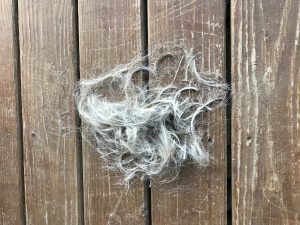
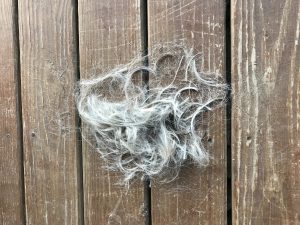
Hair on the porch floor

Share this:

  • Click to share on Facebook (Opens in new window) Facebook
  • Click to share on X (Opens in new window) X
  • Click to email a link to a friend (Opens in new window) Email
  • Click to share on WhatsApp (Opens in new window) WhatsApp

Like this:

Like Loading...

Filed Under: COVID-19, Females/Pick on Peg, Gavel Gamut, Indiana, JPeg Osage Ranch, Martyrs, Mt. Vernon, Oklahoma, Pawhuska, Personal Fun Tagged With: 'Ole 19, a true depression, beautician, beauty shop, Bob Butts, Clyde Ensley, Covid Virus, electric chair, electric clippers, expletives, Gentle Reader, hair cut, Indiana, James M. Redwine, Jim Redwine, Joan of Arc, martyr, Mason-Dixon Line, Mother Nature, Mt. Vernon, Oklahoma, pair of scissors, Pawhuska, Peg, recession, shrieks, sobs, Steve Burris, upstate New York, Vidal Sassoon

A Thousand Words

June 19, 2020 by Peg 2 Comments

I was born in Pawhuska, Osage County, Oklahoma where I spent my first 19 years (1943-1962). Osage County is adjacent to Tulsa and Tulsa County. The Tulsa race riots of 1921 were never mentioned during my 12 years of public education and one year at Oklahoma State University.

I served as a judge in Mt. Vernon, Posey County, Indiana from 1981-2018. Until March 14, 1990 the lynchings of African Americans that took place on the courthouse campus on October 12, 1878 were unknown to me and never brought to my attention.

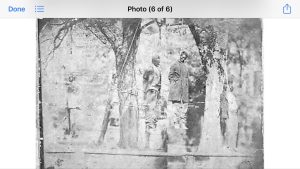
Upon being made aware of the Posey County murders I began to search for more complete information. A friend of mine, Glenn Curtis, who was born and raised in Posey County advised me he had seen a photograph of the 4 young Black men hanging from locust trees outside the courthouse door. He told me he remembered the elongated necks, swollen tongues and cue ball sized eyes of the hanging bodies. I have searched for a copy of that photograph since 1990.

October 12, 1878 Mt. Vernon, Indiana Courthouse Campus

My friend, Doug McFadden, who was also born and raised in rural Posey County told me that his grandfather told Doug that the day after the lynchings Doug’s grandfather watched as white citizens used the hanging young Black men for target practice. And while there was no photograph taken of the young Black man Daniel Harrison, Jr. who on October 10, 1878 was burned to death in the fire box of a locomotive in Mt. Vernon, another Posey County native friend of mine, Basil Stratton, told me that his grandfather, Walker Bennet, was an eyewitness. Walker told Basil that as a young boy he was present and saw several white men, including Walker’s father, force Harrison into the steam engine. Basil’s grandfather told Basil he never forgot the Black man’s screams and the smell of his burning flesh.

I have long thought that a photograph of the lynchings might be the evidence needed to finally get a memorial to the victims erected on the Posey County Courthouse campus. And yesterday my friends, Liz and Jeff Miller of Posey County, emailed me a copy of just such a photograph. Jeff and Liz received the copy from our mutual friend and historian, Ray Kessler of Mt. Vernon. Ray told me when we spoke by phone last night that he got the photograph from Karen McBride Christensen of Indianapolis who retrieved the picture from Georgia’s Emory University archives. I do not, as yet, know how it came to be there. Because of its graphic nature I have not attached it to this newspaper article. However, it did call me to reprise an article on race relations I first published July 4, 2005. Gentle Reader, as recent events may lead one to conclude the issues discussed in that article remain raw in our national psyche today, I offer it once more for your consideration.


HAPPY BIRTHDAY TO U.S.!

LET’S HAVE A PARTY AND INVITE EVERYONE!

(Week of July 4, 2005)

The United States Supreme Court has occasionally succumbed to popular opinion then later attempted to atone for it.  The Dred Scott (1857) and Plessy v. Ferguson (1892) cases come to mind as examples of institutionalized injustice with the partial remedy of Brown v. Board of Education (1954) being administered many years later.

In Dred Scott, the U.S. Supreme Court decided that American Negroes had no rights which the law was bound to protect as they were non-persons under the U.S. Constitution.

And in Plessy, the Court held that Mr. Plessy could not legally ride in a “whites only” railroad car.  The Court declared that laws that merely create distinctions but not unequal treatment based on race were constitutional.  SEPARATE BUT EQUAL was born.

Our original U.S. Constitution of 1787 disenfranchised women, and recognized only three-fifths of every Black and Native American person, and even that was only for census purposes.  Our Indiana Constitution of 1852 discouraged Negro migration to our state in spite of Posey County Constitutional Convention Delegate, Robert Dale Owen’s, eloquent pleas for fair treatment for all.

Were these documents penned by evil men?  I think not.  They were the result of that omnipotent god of politics, compromise, which is often good, but sometimes is not.  Should you have read this column recently you may recall that I strongly encourage compromise in court, in appropriate cases.

However, as one who grew up in a state where the compromise of the post Civil War judges and politicians led to the legal segregation of schools, restaurants, and public transportation, I can attest that some compromises simply foist the sins of the deal makers onto future generations.

When I was 6 years old, my 7 year old brother, Philip, and I made our first bus trip to our father’s family in southern Oklahoma.

We lived on the Osage Indian Nation in northeastern Oklahoma.  It sounds exotic but our hometown, Pawhuska, looked a lot like any town in Posey County.

In 1950 our parents did not have to worry about sending their children off with strangers except to admonish us not to bother anyone and to always mind our elders.

When mom and dad took us to the MKT&O (Missouri, Kansas, Texas and Oklahoma) bus station it was hot that July day.  Oklahoma in July is like southern Indiana in July, WITHOUT THE SHADE TREES!

My brother and I were thirsty so we raced to the two porcelain water fountains in the shot gun building that was about 40 feet from north to south and 10 feet from east to west.

Phil slid hard on the linoleum floor and beat me to the nearest fountain.  And while I didn’t like losing the contest, since the other fountain was right next to the first one, I stepped to it.

“Jimmy, wait ‘til your brother is finished.  James Marion! I said wait!”  Dad, of course, said nothing. He didn’t need to; we knew that whatever mom said was the law.

 “Mom, I’m thirsty.  Why can’t I get a drink from this one?”

 “Son, look at that sign.  It says ‘colored’.  Philip, quit just hanging on that fountain; let your brother up there.”

Of course, the next thing I wanted to do was use the restroom so I turned towards the four that were crammed into the space for one:  “White Men”, “White Ladies”, “Colored Men”, and “Colored Women”.

After mom inspected us and slicked down my cowlick again, we got on the bus and I “took off a kiting” to the very back.

I beat Phil, but there was a man already sitting on the only bench seat.  I really wanted to lie down on that seat but the man told me I had to go back up front.  And as he was an adult, I followed his instructions.

Philip said, “You can’t sit back there.  That’s for coloreds.  That’s why that colored man said for you to go up front.”

That was the first time I noticed the man was different.  That was, also, the point where the sadness in his eyes and restrained anger in his voice crept into my awareness.

As a friend of mine sometimes says, “No big difference, no big difference, big difference.”

And if all this seems as though it comes from a country far far away and long long ago, Posey County segregated its Black and White school children for almost 100 years after 600,000 men died in the Civil War.  In fact, some of Mt. Vernon’s schools were not fully integrated until after Brown was decided in 1954.

And, whether we have learned from our history or are simply repeating it may depend upon whom we ask.  Our Arab American, Muslim, Black, Native American, and Hispanic citizens, as well as several other “usual suspects”, may think the past is merely prologue.

Sometimes it helps for me to remember what this 4th of July thing is really about.  It’s our country’s birthday party; maybe we should invite everyone.

There is nothing equal about separate.

Share this:

  • Click to share on Facebook (Opens in new window) Facebook
  • Click to share on X (Opens in new window) X
  • Click to email a link to a friend (Opens in new window) Email
  • Click to share on WhatsApp (Opens in new window) WhatsApp

Like this:

Like Loading...

Filed Under: America, COVID-19, Democracy, Events, Gavel Gamut, Law Enforcement, Mt. Vernon, Oklahoma, Osage County, Posey County, Posey County Lynchings, Prejudice, Slavery Tagged With: 4 Black men hanging from locust trees, Basil Stratton, Brown v. Board of Education, Daniel Harrison Jr., Doug McFadden, Dred Scott, Gentle Reader, Glenn Curtis, Indiana, James M. Redwine, Jim Redwine, Karen McBride Christensen, Liz & Jeff Miller, lynchings, Mt. Vernon, Oklahoma, Osage County, Pawhuska, Plessy v. Ferguson, Posey County, Ray Kessler, Robert Dale Owen, Separate but Equal, the usual suspects, there is nothing equal about separate, Tulsa race riots, Walker Bennet

Hoosiers and Slave Auctions

August 3, 2018 by Peg Leave a Comment

Gentle Reader, you will, of course, remember the Gavel Gamut column of December 05, 2005 where one of Posey County, Indiana’s most infamous brawlers was mentioned. One Tom Miller was fond of drink and when drinking was fond of fighting. In the years just before the Civil War old Tom would get liquored up and lick whoever had the misfortune to run into him on the streets of Mt. Vernon, Indiana. As described by John Leffel in the Western Star newspaper Miller would, “Pace the streets of Mt. Vernon with his coat off, sleeves rolled up, his shaggy breast exposed and his suspenders about his waist.” According to the editor, Tom always bellowed the same challenge, “I’m a mean man, a bad man and I orter to be whipped, I know, but whar’s the man to do it?”

Tom Miller was only one small part of our Posey County and new state of Indiana’s reputation for tumultuous living. The sobriquet, “Hoop Pool Township”, was fairly earned by Posey County brawlers who drove visiting boatmen away. And as for frontier justice in Indiana, some experts assert our Hoosier nickname came about from the proclivity of Indiana rowdies to bite off ears and spit them out onto barroom floors.

I am indebted to columnist Erik Deckers who set forth this theory of the origin of the word “Hoosier” in his article contained in the publication Here and Wow, Indianapolis! Vol.1, No. 1, 2018. At page 22 Deckers attributed this possibility to Indiana’s poet laureate James Whitcomb Riley (1849-1916) of When the Frost is on the Pumpkin fame who claimed that early Indiana folks would frequently gouge out eyes or bite off body parts which would litter a barroom floor and when the next day someone would kick the removed piece of fleck they’d ask, “Whose ear?”

If I had not dealt with so many cases in court where the behavior of the combatants resembled such activity I might look askance on such a theory. However, I can see some merit to Riley’s analysis.

Well, onto another topic as discussed in last week’s column. You do remember last week’s column, right? Okay, it involved military service and concentrated on my Great Great Grandfather, John Giggy who was a stone mason and farmer from La Grange, Indiana who fought all four years (1861-1865) in Company H of the famed Iron 44thIndiana Volunteer Infantry.

Before being wounded at both Shiloh and Chickamauga and before he saw his first shot fired he and his outfit witnessed a sad spectacle in Henderson, Kentucky that helped them understand one of the main reasons they went to war. Kentucky did not secede, but it did have legal slavery until 1865. In fact, one reason Tom Lincoln, Abraham’s father, moved his family from Kentucky to Indiana was to avoid competing for work with slave labor. Slavery was part of the legal and social culture of Kentucky. The young Hoosier farm boys from northern Indiana who were used to doing their own labor had not had direct knowledge of The Peculiar Institution until they personally observed a slave auction in 1861 just across the Ohio River as they were making their way south:

“It was a strange pitiful sight that of women and little children standing upon the action block to be sold as human chattles. They came wringing their hands and with tears and sobs, lamenting their cruel fate. The soldiers stood near filled with pity and indignation but restrained by law and discipline. Slavery existed at this point in its mildest form. Here were a dozen or more large tobacco factories. The blacks were required as a daily task to strip 400 pounds under penalty of the rod. Children of ten years were given this task. Work hours extended from 4 a.m. to 8 p.m. In each room was an overseer whose presence was a threat. Some negroes were well dressed, others ragged. Attendance at church was allowed and many were Christians. They regarded the coming of the soldiers as the precursor of their liberty.”

As to the name Hoosier, Posey County’s most famous citizen, Major General Alvin P. Hovey, while in command at Shiloh came across a Union sentry on a dark night who asked for the password. Hovey was just getting his men to that position and had no idea what password was being used. When the sentry asked, “Who goes there?”, Hovey improvised what he hoped would be an acceptable password and responded, “Hoosiers”. The sentry said, “Welcome Hoosiers.” Apparently, we Hoosiers have been welcomed as such for a long time.

Share this:

  • Click to share on Facebook (Opens in new window) Facebook
  • Click to share on X (Opens in new window) X
  • Click to email a link to a friend (Opens in new window) Email
  • Click to share on WhatsApp (Opens in new window) WhatsApp

Like this:

Like Loading...

Filed Under: America, Gavel Gamut, Indiana, Mt. Vernon, Mt. Vernon, News Media, Posey County, Slavery Tagged With: Abraham Lincoln, Alvin P. Hovey, Chickamauga, Civil War, Company H of the Iron 44th Indiana Volunteer Infantry, Gentle Reader, Henderson Kentucky, Hoop Pole Township, Hoosiers, Indiana, James M. Redwine, James Whitcomb Riley, Jim Redwine, John Giggy of La Grange Indiana, John Leffel, Mt. Vernon, Posey County, Shiloh, slave auctions, slavery, Tom Lincoln, Tom Miller, Western Star

Mucho Mulch

May 4, 2018 by Peg 1 Comment

Ah, spring! The hummingbirds have returned to JPeg Ranch and the falling locust tree blossoms can make me forget for a while how the thorns attack me each time I must deal with a fallen branch. The air is filled with perfume and a symphony of avian love songs.

Of course, it is not called spring for nothing and the Equinox strikes deeply into Peg’s cortex causing her to spring into a frenzy of projects around the Ranch. Unfortunately for me Peg’s projects become my sentence.

Then there is Peg’s deeply held belief we should contribute to virtually every cause that advances the beauty of Posey County, especially New Harmony. The confluence of her obsessions of yard improvement and public service converged when our friend Barb McConnell, who is a hardworking member of the New Harmony Garden Club, mentioned to Peg that the club was selling bags of mulch as a fundraiser.

Now, New Harmony is our home and we care about it. My affection for our small village is best expressed by patronizing Sara and David Brown’s Coffee and Wine Shop, David and Vicki Campbell and Sara and David Brown’s microbrewery, Kenny and Nancy Weinzapfel’s Yellow Tavern and the Owen family’s Red Geranium Restaurant. My position is I spend money on a good meal and/or a good glass of red wine, then I have well met my duty to improve our community. With Peg that’s not quite enough. Therefore, Peg bought 120 (you did not misread that figure) of brown mulch from Barb and the Garden Club.

When Peg gave me the good news my first thought was, “Okay, you bought the mulch, you must want to lift, move, open and spread every last 50 pound bag of it.” Gee, how could I have ever had such a fleeting dream? Oh, no, Peg demanded that I have the pleasure of spending an entire weekend frolicking in the yard with enough mulch to recreate the Old Plank Road between New Harmony and Mt. Vernon.

We put mulch on every possible tree, shrub, flower bed and mole hole within sight. The left over was used to get ready for our grandson’s wedding to be held at the Ranch this month. I bit my tongue when the thought arose, “Does the happy couple really want to stand on a 3 foot high pile of mulch to take their vows?”

Share this:

  • Click to share on Facebook (Opens in new window) Facebook
  • Click to share on X (Opens in new window) X
  • Click to email a link to a friend (Opens in new window) Email
  • Click to share on WhatsApp (Opens in new window) WhatsApp

Like this:

Like Loading...

Filed Under: Events, Family, Females/Pick on Peg, Gavel Gamut, JPeg Ranch, Mt. Vernon, New Harmony, Posey County Tagged With: Barb McConnell, David and Vicki Campbell and Sara and David Brown’s microbrewery, Equinox, grandson’s wedding, hummingbirds, James M. Redwine, Jim Redwine, JPeg Ranch, Kenny and Nancy Weinzapfel’s Yellow Tavern, locust tree blossoms, Mt. Vernon, mulch, New Harmony, New Harmony Garden Club, Old Plank Road, Posey County, red wine, Sara and David Brown’s Coffee and Wine Shop, Spring, the Owen family’s Red Geranium Restaurant

Doug McFadden Knew Where We Came From

June 16, 2017 by Peg 5 Comments

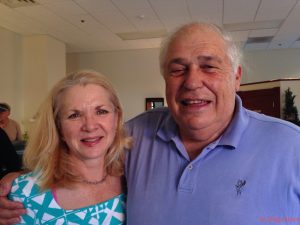
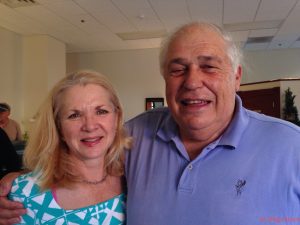
   Debbie & Doug McFadden

Douglas Bruce McFadden died June 14, 2017 and took a lot of intellect, humor and history with him. Fortunately, he wrote a book, The McFaddens: A Family of Frontiersmen 1258-1950 (now 2017), which left us his Posey County historical legacy.

Doug was great fun to talk with about history and politics; he knew both subjects thoroughly. Of course, his family was the McFaddens of McFaddens Bluff, now Mt. Vernon, Posey County, Indiana. When the McFaddens landed here in 1805 they were greeted personally by General William Henry Harrison who told young Mary McFadden she was the first white woman to land in the Indiana Territory, which was then part of the Northwest Territory.

As Doug says in his book: “The McFadden name has several spellings depending on the mood of the individual … All belong to the same Scottish Clan that originated in the 12th century.” Father George Rapp when he was trying to buy land for his New Harmonie community wrote several letters and referred to the owners variously as McFadin, MacFahrlin, McFadians and McFadden from whom he sought to buy land at less than $15.00 per acre.

To have had the pleasure of knowing Doug was to know the history of not only Posey County, Indiana but also America, directly and personally. As Doug said in the Introduction to his book:

“This is not a story about celebrity or fame but of courageous, honest, hardworking people … who participated in the carving of a new nation and the building of America.”

That pretty well describes Doug. Even those of you who did not have the pleasure of his company have suffered a deep loss.

Share this:

  • Click to share on Facebook (Opens in new window) Facebook
  • Click to share on X (Opens in new window) X
  • Click to email a link to a friend (Opens in new window) Email
  • Click to share on WhatsApp (Opens in new window) WhatsApp

Like this:

Like Loading...

Filed Under: America, Gavel Gamut, Indiana, McFaddens Bluff, Mt. Vernon, New Harmonie, Posey County Tagged With: America, Doug McFadden, Douglas Bruce McFadden, Father George Rapp, General William Henry Harrison, Indiana Territory, James M. Redwine, Jim Redwine, MacFahrlin, McFadians, McFadin, Mt. Vernon, New Harmonie, Northwest Territory, Posey County, Scottish Clan, The McFaddens: A Family of Frontiersmen 1250-1950

Mary Poppins Revisited

March 21, 2017 by Peg Leave a Comment

While not an umbrella, the EHang184 Autonomous Aerial Vehicle promises vertical take off and landing. The oval shaped 440-pound plastic egg made in China will be available for you and your one 16-inch carryon bag starting this July.

Sheikh Mohammed bin Rashid Al Maktoum, Royal Crown Prince of the United Arab Emirates, decreed that by the year 2030 he wants at least 25% of passenger traffic in Dubai to be via autonomous vehicles. He did not decree a price per trip but since my young friend Andy Minnette was charged $100.00 about ten years ago there for the privilege of riding an elevator to the top of the Burj Khalifa, the world’s tallest building, I presume we’re not talking rickshaw prices.

According to the propaganda sheet from EHang, there will be no need for a license or special training. If one weighs 220 pounds or less he or she would just throw in a bag, lock the dome of the 18-foot long device, punch in a destination and push a button. Then it’s, Jetsons here we come!

The E184 can travel 60 miles an hour and fly for 23 minutes on one electrical charge. It has four legs with 2 rotors on each leg, is 5 feet in maximum height and has what EHang asserts is a “failsafe system” that is also constantly monitored from a “control center”. The occupant has no way to escape, e.g., parachute out.

The cost appears to me to be rather in flux. EHang says for a mere $200,000 to $300,000 you can be the proud owner of this glorious egg. It does fold up and can be parked in a regular parking space or outside your mansion.

Autonomous automobiles are about the only analogous vehicles for comparison. As of March 08, 2017 Uber reported its 43 unmanned cars, which by the way are manned by an operator, averaged less than one mile of driving before a human had to take over to avoid an “incident”. If you should have such an “incident” 500 feet in the air in your E184, “Good Luck!”, as they say in Las Vegas.

Now, I am not a Luddite. I like technology such as Cable TV and air conditioning. However, in Posey County, Indiana it might be somewhat premature to ask the County Commissioners and County Council for a Circuit Court EHang 184. After all, the last time I arrived at the stoplight in New Harmony when there was more than one other vehicle was during the Christmas parade. As for the Mt. Vernon intersection of Fourth and Main by the Courthouse, I did have to wait almost 10 seconds once last week. Maybe Dubai is busier.

Another concern I have with the use of the EHang 184 was raised by its announcement being accompanied by solicitations for financing options and available life insurance plans. However, my true reluctance was caused by the companion article from the Transportation Security Administration (TSA) that cautioned it was already developing guidelines and hiring thousands of high school dropouts for strip searching anyone who wishes to fly in an EHang 184.

Share this:

  • Click to share on Facebook (Opens in new window) Facebook
  • Click to share on X (Opens in new window) X
  • Click to email a link to a friend (Opens in new window) Email
  • Click to share on WhatsApp (Opens in new window) WhatsApp

Like this:

Like Loading...

Filed Under: America, Circuit Court, Gavel Gamut, Middle East, Personal Fun, Posey County Tagged With: Andy Minnette, autonomous vehicles, Burj Khalifa, Circuit Court, control center, County Commissioners, County Council, Dubai, EHang 184 Autonomous Aerial Vehicle, failsafe system, Good Luck as they say in Las Vegas, James M. Redwine, Jetsons, Jim Redwine, Luddite, made in China, Mary Poppins, Mt. Vernon, New Harmony, Posey County Indiana, Royal Crown Prince of the United Arab Emirates, Sheikh Mohammed bin Rashid Al Maktoum, Transportation Security Administration, TSA, Uber

© 2026 James M. Redwine


Loading Comments...
 

    %d