
• Skip to primary navigation
  • Skip to main content

James M. Redwine

  • Books
  • Columns
  • 1878 Lynchings/Pogrom
  • Events
  • About

lynchings

You Can Go Home Again and Again

January 1, 2023 by Peg Leave a Comment

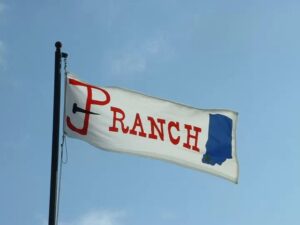
JPeg Ranch in Indiana. Photo by Peg Redwine

For many satisfying years Peg and I made our home in Posey County, Indiana among friends and family. During those years we were blessed with treasured visits from friends and family from out west, mainly my birth state of Oklahoma. Now that we have returned to make our home in Osage County, Oklahoma, as we reconnect with old friends and fond memories, we are occasionally blessed with visits from friends and family from southern Indiana. It is not frequent enough for us but is sweet when it occurs.

Therefore, we were pleased when we received an email from Mt. Vernon, Indiana high school senior, Carlton Redman, saying he had read our book JUDGE LYNCH! that we published in 2008, and for which my sister Jane nee Redwine Bartlett wrote the poignant Foreword. Carlton asked if I would participate in a Zoom call with his English class to discuss the book’s exposé of the long hidden horrific murders of seven Black men in Posey County in 1878; we were gratified for his interest. Carlton’s Redman family has deep roots in Posey County and his grandfather, Carl J. Redman, is an old friend of mine. Carlton’s uncle, Robert Redman, served as my court bailiff for several years. Another of Carlton’s uncles, Martin Ray Redman, was not only a fine public servant but also one of my best friends. Carlton’s cousin, Greg Redman, played baseball and graduated with our son, Jim, from Mt. Vernon High School. And, Dave Pearce along with his wife, Connie nee Redman Pearce, have carried my newspaper column, “Gavel Gamut”, in the Posey County News for many of the column’s 32 years and over 900 articles. In other words, unbeknownst to Carlton before he contacted me, the fine Redman family and my family have many pleasant connections and his aunt and uncle’s newspaper has often helped tell the story of the 1878 lynchings.

But that’s not why Carlton contacted me. He had been assigned by his teacher, Mary Feagley, to do a classroom project and he chose to investigate Posey County’s long and interesting history by reading our book and then having me appear in his class via the Internet on December 16, 2022 to discuss it. I was honored to do so as our son received a fine education from the Mt. Vernon school system and we have only good memories from his time there and our time in Posey County.
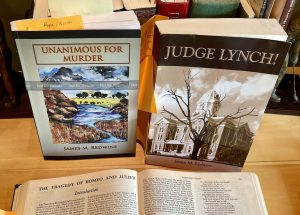
Photo by Peg Redwine

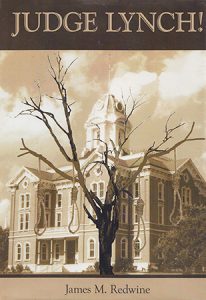
Gentle Reader, I hope you have read or will someday read JUDGE LYNCH! which is a historical novel, but refers to much of Posey County’s rich history. That Ms. Feagley has guided her students to know their own history gratifies but does not surprise me. Mt. Vernon High School has had several excellent teachers, such as Jerry King, who know our future is determined by our past and we need to know it, both good and bad.

In fact, Jerry and his wife, Marsha, appeared in the movie we made in 2011 about the murders of 1878. They reenacted General and Mrs. Alvin P. Hovey and even furnished their wonderful Pioneer Village for sets for the movie, for which my brother, C.E. Redwine, did the haunting music. Numerous Posey County and Evansville, Indiana residents volunteered their time and effort in the movie to help bring the previously hidden and forgotten terrible events of autumn 1878 to light. In fact, that movie premiered in my hometown of Pawhuska, Oklahoma at the Constantine Theater on June 11, 2011 at the First Ben Johnson Film Festival and has been shown several times in New Harmony, Indiana and elsewhere since then. JUDGE LYNCH!, its sequel, Unanimous for Murder published in 2021 that incorporates history from both Posey County and Osage County, and the movie are available at the Alexandrian Public Library in Mt. Vernon and Capers Emporium in New Harmony, Indiana. In Oklahoma they are available at the Pawhuska Public Library, the Osage County Historical Society Museum and Woolaroc Museum. And then, of course, from our website, www.jamesmredwine.com.

Carlton, his teacher and his classmates are helping the community remember what we must not forget, ignore or repeat. Thank you Carlton and Ms. Feagley. I was honored to serve forty years as a Posey County Judge and was honored to have JUDGE LYNCH! used to help preserve and expose our history.

Now that we live in Oklahoma we occasionally get to re-visit southern Indiana and see family and friends there. These times are rare but valued treasures, just as we used to feel when we lived in Indiana and visited Oklahoma. What Peg and I have found to our delight is that if one lives in both Posey County, Indiana and Osage County, Oklahoma, you have two homes and you CAN go home again, repeatedly.

“The Veranda” at JPeg Osage Ranch. Photo by Peg Redwine

Share this:

  • Click to share on Facebook (Opens in new window) Facebook
  • Click to share on X (Opens in new window) X
  • Click to email a link to a friend (Opens in new window) Email
  • Click to share on WhatsApp (Opens in new window) WhatsApp

Like this:

Like Loading...

Filed Under: Authors, Friends, Gavel Gamut, Mt. Vernon, Osage County, Posey County Tagged With: Alvin P. Hovey, Carlton Redman, family and friends, Gentle Reader, Home, James M. Redwine, Jim Redwine, JUDGE LYNCH!, lynchings, Mary Feagley, Mt. Vernon school system, murders of seven Black men, Osage County, Peg, Posey County, Posey County News, Unanimous for Murder, you can go home again

Not Rocket Science

January 13, 2022 by Peg 3 Comments

The Rule of Law is not the stuff of artificial intelligence and differential equations. It is not about the James Webb telescope that may help disclose where and when we came from. It is not about a cure for COVID. No, the Rule of Law is far more complex, and perplexing, than any of those things. However, if properly applied, the Rule of Law can help us understand and deal with these challenges and others.

Law sounds simple. Treat others the way you wish to be treated. Respect the person and property of others. These principles are easy to say but thousands of years of human history prove they are extremely difficult to apply. Our Declaration of Independence sets out the basics of our legal system, “…[A]ll men are created equal,” and all men have the right to life, liberty and the pursuit of happiness. When Thomas Jefferson penned those simple ideals he owned slaves, and had children he did not acknowledge by at least one of those slaves. Also, women could not vote and the property rights of Native Americans were not even an afterthought. Were Jefferson and the rest of the 1776ers evil? No, they were human. We call these concepts ideals because the realities are nearly impossible to achieve. That is why we need the Rule of Law, to encourage us to try.

Our Constitution sets forth America’s aspiration to form a more perfect union. Surely none of our Founders was naïve enough to believe perfect self-government was achievable. That is not why goals are set. Just as it is the struggle of life that can separate us from all other animals and, perhaps from some humans, it is government’s role to help us strive for perfection. We have often fallen short and we always will. But just as we are fighting the war on COVID in fits and starts we can face our past failures in how we have behaved and strive to be better. There will never be a cure for our occasional imperfect collective missteps. That is why we need to acknowledge our past failures and seek to avoid future sins. We should do this together.

In her book, On the Courthouse Lawn, Sherrilyn Ifill points out the irony of many lynchings being carried out by large numbers of a community right at the seat of justice, the county courthouse. Also, our courthouses are often the site where the legal system has been used to deny human rights, such as through the separation of Native American families and establishment of some guardianships that led to murder.

Community recognition of these subversions of the Rule of Law is important. Monuments that show society admits its wrongs, even if long past, can help people heal and avoid new injustices.

Share this:

  • Click to share on Facebook (Opens in new window) Facebook
  • Click to share on X (Opens in new window) X
  • Click to email a link to a friend (Opens in new window) Email
  • Click to share on WhatsApp (Opens in new window) WhatsApp

Like this:

Like Loading...

Filed Under: America, Authors, COVID-19, Democracy, Gavel Gamut, Judicial, Native Americans, Posey County Lynchings, Rule of Law, Slavery Tagged With: community recognition, Constitution, county courthouse, COVID, Declaration of Independence, guardianships, James M. Redwine, James Webb, Jim Redwine, lynchings, monuments, Native Americans, On the Courthouse Lawn, rule of law, Sherrilyn Ifill, slaves, Thomas Jefferson

“Organized”

October 8, 2021 by Peg Leave a Comment

On September 18, 2021 I received an email from Mr. Ben Uchitelle, Attorney at Law, in Clayton, Missouri. Mr. Uchitelle had read my book JUDGE LYNCH! and found my email address, jmredwine@aol.com, from my website, www.jamesmredwine.com.

Mr. Uchitelle’s Great Grandfather was Manuel Cronbach who was a prominent citizen of Mt. Vernon, Posey County, Indiana who at age seventeen in 1878 personally observed the lynched bodies of four Black men hanging in the center of town on the courthouse lawn. Mr. Uchitelle’s Great Grandfather described the murders in his short autobiography. Mr. Uchitelle shared his Great Grandfather’s observations with me:

“The negro had no social standing in Mt. Vernon but they did not seem to feel any the worse for this. They were treated well so long as they knew their place. One of the great tragedies of their lives in Mt. Vernon was the lynching of four of their number by a mob. Oscar Thomas, a white deputy sheriff, was going to the home of a colored man to arrest him, was shot and killed. Feeling ran high, a white mob was at once organized and four of their number were hanged on trees in the Public Square, and it is claimed that one negro man was put into the fire box of an incinerator and burned to death. How many of the lynched negroes were guilty I do not know, but the bodies of those hanged in the Public Square dangled in the air nearly all next day. I asked the coroner, Uncle Bill Hendricks, why he did not cut them down. He answered, ‘I hain’t had no official notice that they are dead.’ Certainly a profound and unanswerable reason.”

I appreciate Mr. Uchitelle sharing this eye-witness account with me and urge others who might have historical records of the 1878 murders such as letters or diaries to contact me. The truth has no statute of limitations.

From my first knowledge of these horrific events that Oscar Thomas’ descendant, Ilse Horacek, gave to me in 1990, I have sought to uncover the facts. What I do know from my research is that Mr. Manuel Cronbach’s poignant comments illustrate the attitude of the general population of Mt. Vernon and Posey County, Indiana in 1878 and, perhaps, long after. As a practicing Posey County Attorney, Posey County Chief Deputy Prosecuting Attorney, County Attorney and Posey County Judge for a total of well over forty years I find the callous official attitude of Coroner Hendricks to be one of the saddest aspects of the whole matter.

Other portions of Mr. Cronbach’s account that are pregnant with what they do not say is his question as to how many of the lynch victims were guilty. Since none of the four lynched men were involved in the death of Officer Thomas, the answer is zero. And Mr. Daniel Harrison, Sr. who was involved was grabbed and chopped into pieces and his parts were dumped in the jail outhouse.

But the word in Mr. Cronbach’s account that most loudly calls out to me is “organized”, as John Leffel, who was the owner and editor of the local Western Star newspaper in 1878, reported that two to three hundred white, male citizens of Posey County, Indiana organized themselves into a well-regimented, armed group and marched onto the courthouse lawn and murdered all five Black men.

As I have done since 1990, I am still calling for the community to finally and publicly atone for the sins of 1878 and erect a memorial to the victims on the courthouse square. Thank you, Attorney Ben Uchitelle, for contacting me and for your interest in justice, even if justice remains long delayed.

Share this:

  • Click to share on Facebook (Opens in new window) Facebook
  • Click to share on X (Opens in new window) X
  • Click to email a link to a friend (Opens in new window) Email
  • Click to share on WhatsApp (Opens in new window) WhatsApp

Like this:

Like Loading...

Filed Under: Events, Gavel Gamut, Indiana, Mt. Vernon, Posey County, Posey County Lynchings, Segregation Tagged With: 1878 murders, Ben Uchitelle, eye-witness account, Ilse Horacek, James M. Redwine, Jim Redwine, JUDGE LYNCH!, justice, lynchings, Manuel Cronbach, Mt. Vernon Indiana, Negro, organized, Oscar Thomas, Posey County, publicly atone for sins, truth

Positive or Negative

September 30, 2021 by Peg Leave a Comment

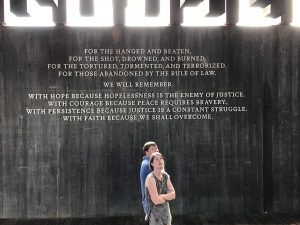
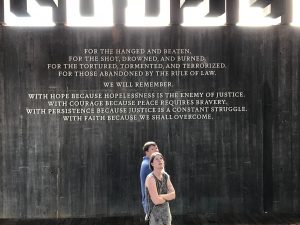
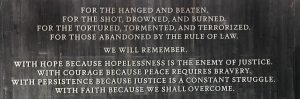
Equal Justice Initiative National Memorial Montgomery, Alabama


There is no memorial on the Posey County, Indiana courthouse lawn to the seven Negroes murdered by a white mob on October 12, 1878. There is a modest stele naming those soldiers with Posey County connections who served in   the Revolutionary War and an impressive statue honoring all who served in the Civil War. There are bronze plaques on the lobby walls of the Posey County Coliseum commemorating many of those who served. The Coliseum houses one of Posey County’s two courts and the other court is located in the courthouse.

Because I was the elected Posey Circuit Court Judge and because our son, James David Redwine, was a West Point graduate who would later earn a Bronze Star for Service on the front lines of both the Gulf War 1990-1991 and the Iraq War of 2003-2011 I was asked to speak at both the War Memorial Re-Dedication on Sunday, October 21, 1990 and Re-Dedication of the Soldiers and Sailors Monument on July 23, 2008. I was honored to do so and wrote the following poems for the occasions. The poems appeared in several newspapers after each commemoration:


WAR MEMORIAL RE-DEDICATION
(Sunday, October 21, 1990)

SUNDAY MORNING CHIMES

How dear it is to be alive:
To hear the peal of morning chimes;
To feel the invigorating sting of this autumn day;
To taste the rich and biting air;
To smell the acrid smoke of burning leaves;
To see the glory of Nature’s third act.

How satisfying to still be a player:
To know a child’s trust;
A family’s support;
A friend’s companionship; or
A lover’s caress.

How thrilling it is to learn,
To plan,
To strive
To serve,
To live!

These wondrous things:  These sensations;
These desires;
These dreams;
These visions.  This life,
Is what these heroes have sacrificed for us.

RE-DEDICATION OF THE SOLDIERS AND SAILORS MONUMENT
(Wednesday, July 23, 2008)

WELL DONE!

At Lexington and Concord, the young blood began to flow.
At the Battle of New Orleans, muskets killed our cousins and our foes.

At the Alamo and Buena Vista, we stood to the last man.
At Shiloh, Chickamauga and Gettysburg, brothers’ blood soaked the sand.

At San Juan Hill and when the Maine went down, our soldiers never flinched.
At Verdun and by the Marne, a million men died in the trench.

At D-Day and the Battle of the Bulge, after Hiroshima’s mushroom clouds,
At Incheon Landing the forgotten war brought many more funeral shrouds.

At Khe Sanh and during Tet, we held our own and more.
At the Battle of Medina Ridge, our Gulf War warriors upheld the Corps.

At Sinjar, Mosul, and places with strange names,
Our Iraqi War veterans now earn their fame.

In uniforms, our citizens have served well everyone.
Today, we here proclaim to them our solemn praise:  Well done!


It is fitting and proper that we honor those who serve and that we are permanently reminded of the horrors of war. Society needs to be constantly on guard and eternally grateful. Of course, the reasons that call for memorials about wars are much the same as why we need memorials to our collective evil done to some citizens by other citizens.

Since I first discovered, by accident, in 1990 the legal system’s long covered up murders of Daniel Harrison, Sr., Daniel Harrison, Jr., John Harrison, James Good, Ed Warner, William Chambers and Jeff Hopkins by, as the Mt. Vernon, Indiana Western Star Newspaper said on October 17, 1878, “two to three hundred of the county’s best white citizens” right on the Posey County, Indiana courthouse campus, I have called for accountability and a memorial to the victims. Society owes this atonement to the victims and we as a society need it for ourselves.

What the sign says. Pictures by Peg Redwine

Share this:

  • Click to share on Facebook (Opens in new window) Facebook
  • Click to share on X (Opens in new window) X
  • Click to email a link to a friend (Opens in new window) Email
  • Click to share on WhatsApp (Opens in new window) WhatsApp

Like this:

Like Loading...

Filed Under: America, Events, Gavel Gamut, Judicial, Law Enforcement, Military, Mt. Vernon, News Media, Posey County, Posey County Lynchings, War Tagged With: accountability, atonement, Bronze Star, Civil War, Daniel Harrison Jr., Daniel Harrison Sr., Ed Warner, Gulf War, Iraq War, James David Redwine, James Good, James M. Redwine, Jeff Hopkins, Jim Redwine, John Harrison, legal system's long covered up murders, lynchings, memorial to lynching victims, Mt. Vernon Western Star Newspaper, October 12 1878, Posey Circuit Court Judge, Posey County Coliseum and courthouse, Posey County Indiana courthouse lawn, Re-Dedication of Soldiers and Sailors Monument, Revolutionary War, War Memorial Re-Dedication, West Point, white mob, William Chambers

Independence Day

June 26, 2020 by Peg 1 Comment

Lexington Minuteman
Lexington Battle Green, MA

The Fourth of July is called Independence Day with good reason. Our Founders were willing to die for the right to control their own lives. They were not seeking war with the most powerful nation on Earth in 1776. They were not attempting to dictate to King George III how the English should behave. They sought only free will for America to determine its own course. In these troubled times we are now navigating, perhaps a look back to America’s early struggles might be helpful.

We may wish we could ask George Washington or James Madison for advice. But the best we can do is read about past heroes’ courage and sacrifice and try to learn lessons that will help us during our own battles.

For example, one of my heroines is Frances (Mad Fanny) Wright, that fighter for women’s rights, Black rights and freedom from religion who spoke in New Harmony, Indiana on July 04, 1828. Oh, how much we could learn if we could speak with her now. However, we do know she dedicated her life and fortune to eliminating slavery. Had she lived only nine more years she would have experienced the start of the Great Struggle that ended a whole race of Americans’ loss of control over their lives.

Control, isn’t that what matters most to all of us? The visceral need for the freedom to make our own choices is why on that day we now call Patriots Day, April 19, 1775, at Lexington and Concord those suppressed colonists “Fired the shots heard ’round the world”. And in our current political climate when Americans get embroiled in political discussions it sometimes feels as if both sides have muskets at the ready.

When I find myself surrounded by the competing political mini balls, I try to remember this is nothing new. Over the two or three hundred thousand years we Homo sapiens have been around, after air, water, food, shelter and procreation we seem to have two more basic needs: the control of our own lives; and the strong desire to control the thoughts and behavior of others. These two related but directly oppositional impulses apply to groups of people and nations as well. You know, we will each defend to the death the right of our political adversaries to agree with us. But conversations can rapidly turn to confrontation if someone comes down on what we believe is the wrong side of such issues as religion, race, global warming, immigration, war and peace, who should or should not be President of the United States and a thousand other subjects.

The right to control our own lives makes us smile. The desire to control other peoples’ lives can lead to such things as vitriolic statements and sometimes even vicious interchanges in our public and interpersonal interactions. Sometimes today’s discussions about control may center on sexual assault and the “Me Too Movement” or hate crimes and “Black Lives Matter”.

Rape is a terrible crime not because of forced sexual contact, billions of humans have had sexual relations. No, rape is a terrible crime because of the victims’ loss of their right to decide for themselves whether and with whom to have sex. The fear, terror, anger and humiliation caused by losing total control of one’s body is incalculable. It is in itself a life sentence that can lead to permanent bitterness toward and distrust of our legal system much as lynchings can result in an entire race of people living with constant concern about their freedom.

Lynchings, such as those that were committed on the Posey County, Indiana courthouse lawn on October 12, 1878, are a collective denial of another’s right to control their own destiny. And it is not just the victims who lose, but even those who deny justice to others may reap the whirlwinds of retaliation and political correctness.

Wars of aggression, not constitutionally authorized wars for national defense, are our country’s intentional denial of another country’s or people’s right to independently determine their own destiny. One of the main causes of our country’s post-WWII denials of the right of other countries to control their own lives are wars instigated by independent executive action without congressional authorization.

We can each quickly cite evidence of such wars based on false premises and rash executive action. President Lyndon Johnson used the shaky premise of the Tonkin Gulf Resolution to get us hopelessly embroiled in Vietnam. President George W. Bush relied on false intelligence reports that Iraq had weapons of mass destruction and was involved in 9/11. President Bush then precipitously led us into what appears to be an endless and pointless war in the Middle East.  As Pete Seeger’s song “Where Have All The Flowers Gone?” asks us, “When will we ever learn?, when will we ever learn?”

Our Founders’ wisdom of placing the authority to wage war in congress is that such a procedure keeps all of our citizens more closely involved in these grave decisions. And, it requires much more careful deliberation when congress is involved. Also, when we eliminated the military draft, we turned from a citizen minute man type military to a professional and less ecumenical type force. To make the tragic choice to go to war all Americans should feel the direct cost. It is too easy to hire others to impose our will on the powerless. With a professional standing military our armed forces never stand down. And the temptation for any of our presidents to play with these awesome powers as if they were toy soldiers is too intoxicating for most to resist. Of course, the draft is one of the ultimate impositions of loss of control. Our country should only use it when our national survival is truly at issue. And then it should include all able-bodied adult citizens. Not everyone needs to serve on the front lines but everyone can serve somehow.

One of the good things we received from one of our British cousins were John Locke’s Enlightenment philosophies as highlighted by the doctrine of separation of governmental powers. Our independence as a nation has survived great trauma due in large part to our three separate and equal political powers: Executive; Legislative; and, Judicial. We forget this at our peril. Control of our lives is an inherent need for individuals and nations and, if lost, can lead to long-term bad effects for both the invaders and the invaded. Freedom of choice is essential to our personal and national well-being. Our Founders enshrined that opportunity for us in our Constitution and that is what we celebrate on Independence Day as we struggle to afford that right to all of our citizens.


Share this:

  • Click to share on Facebook (Opens in new window) Facebook
  • Click to share on X (Opens in new window) X
  • Click to email a link to a friend (Opens in new window) Email
  • Click to share on WhatsApp (Opens in new window) WhatsApp

Like this:

Like Loading...

Filed Under: America, Democracy, Events, Executive, Gavel Gamut, Judicial, Legislative, New Harmony, Patriotism, Posey County Lynchings, Presidential Campaign, Women's Rights Tagged With: 9/11, Black Lives Matter, Black rights, Constitution, control of our own lives, Enlightenment, Executive power, fired the shots hear 'round the world, Fourth of July, Frances (Mad Fanny) Wright, freedom from religion, freedom of choice, George Washington, global warming, immigration, Independence Day, James M. Redwine, James Madison, Jim Redwine, John Locke, Judicial power, King George III, Legislative power, lynchings, Me Too Movement, our Founders, Patriots Day, Pete Seeger, President George W. Bush, President Lyndon Johnson, race, rape, Tonkin Gulf Resolution, Vietnam, war and peace, wars of aggression, who should or should not be President, women's rights

A Thousand Words

June 19, 2020 by Peg 2 Comments

I was born in Pawhuska, Osage County, Oklahoma where I spent my first 19 years (1943-1962). Osage County is adjacent to Tulsa and Tulsa County. The Tulsa race riots of 1921 were never mentioned during my 12 years of public education and one year at Oklahoma State University.

I served as a judge in Mt. Vernon, Posey County, Indiana from 1981-2018. Until March 14, 1990 the lynchings of African Americans that took place on the courthouse campus on October 12, 1878 were unknown to me and never brought to my attention.

Upon being made aware of the Posey County murders I began to search for more complete information. A friend of mine, Glenn Curtis, who was born and raised in Posey County advised me he had seen a photograph of the 4 young Black men hanging from locust trees outside the courthouse door. He told me he remembered the elongated necks, swollen tongues and cue ball sized eyes of the hanging bodies. I have searched for a copy of that photograph since 1990.

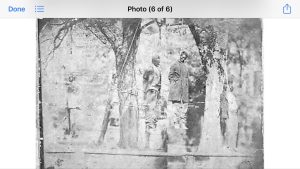
October 12, 1878 Mt. Vernon, Indiana Courthouse Campus

My friend, Doug McFadden, who was also born and raised in rural Posey County told me that his grandfather told Doug that the day after the lynchings Doug’s grandfather watched as white citizens used the hanging young Black men for target practice. And while there was no photograph taken of the young Black man Daniel Harrison, Jr. who on October 10, 1878 was burned to death in the fire box of a locomotive in Mt. Vernon, another Posey County native friend of mine, Basil Stratton, told me that his grandfather, Walker Bennet, was an eyewitness. Walker told Basil that as a young boy he was present and saw several white men, including Walker’s father, force Harrison into the steam engine. Basil’s grandfather told Basil he never forgot the Black man’s screams and the smell of his burning flesh.

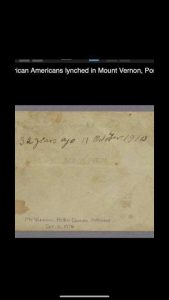
I have long thought that a photograph of the lynchings might be the evidence needed to finally get a memorial to the victims erected on the Posey County Courthouse campus. And yesterday my friends, Liz and Jeff Miller of Posey County, emailed me a copy of just such a photograph. Jeff and Liz received the copy from our mutual friend and historian, Ray Kessler of Mt. Vernon. Ray told me when we spoke by phone last night that he got the photograph from Karen McBride Christensen of Indianapolis who retrieved the picture from Georgia’s Emory University archives. I do not, as yet, know how it came to be there. Because of its graphic nature I have not attached it to this newspaper article. However, it did call me to reprise an article on race relations I first published July 4, 2005. Gentle Reader, as recent events may lead one to conclude the issues discussed in that article remain raw in our national psyche today, I offer it once more for your consideration.


HAPPY BIRTHDAY TO U.S.!

LET’S HAVE A PARTY AND INVITE EVERYONE!

(Week of July 4, 2005)

The United States Supreme Court has occasionally succumbed to popular opinion then later attempted to atone for it.  The Dred Scott (1857) and Plessy v. Ferguson (1892) cases come to mind as examples of institutionalized injustice with the partial remedy of Brown v. Board of Education (1954) being administered many years later.

In Dred Scott, the U.S. Supreme Court decided that American Negroes had no rights which the law was bound to protect as they were non-persons under the U.S. Constitution.

And in Plessy, the Court held that Mr. Plessy could not legally ride in a “whites only” railroad car.  The Court declared that laws that merely create distinctions but not unequal treatment based on race were constitutional.  SEPARATE BUT EQUAL was born.

Our original U.S. Constitution of 1787 disenfranchised women, and recognized only three-fifths of every Black and Native American person, and even that was only for census purposes.  Our Indiana Constitution of 1852 discouraged Negro migration to our state in spite of Posey County Constitutional Convention Delegate, Robert Dale Owen’s, eloquent pleas for fair treatment for all.

Were these documents penned by evil men?  I think not.  They were the result of that omnipotent god of politics, compromise, which is often good, but sometimes is not.  Should you have read this column recently you may recall that I strongly encourage compromise in court, in appropriate cases.

However, as one who grew up in a state where the compromise of the post Civil War judges and politicians led to the legal segregation of schools, restaurants, and public transportation, I can attest that some compromises simply foist the sins of the deal makers onto future generations.

When I was 6 years old, my 7 year old brother, Philip, and I made our first bus trip to our father’s family in southern Oklahoma.

We lived on the Osage Indian Nation in northeastern Oklahoma.  It sounds exotic but our hometown, Pawhuska, looked a lot like any town in Posey County.

In 1950 our parents did not have to worry about sending their children off with strangers except to admonish us not to bother anyone and to always mind our elders.

When mom and dad took us to the MKT&O (Missouri, Kansas, Texas and Oklahoma) bus station it was hot that July day.  Oklahoma in July is like southern Indiana in July, WITHOUT THE SHADE TREES!

My brother and I were thirsty so we raced to the two porcelain water fountains in the shot gun building that was about 40 feet from north to south and 10 feet from east to west.

Phil slid hard on the linoleum floor and beat me to the nearest fountain.  And while I didn’t like losing the contest, since the other fountain was right next to the first one, I stepped to it.

“Jimmy, wait ‘til your brother is finished.  James Marion! I said wait!”  Dad, of course, said nothing. He didn’t need to; we knew that whatever mom said was the law.

 “Mom, I’m thirsty.  Why can’t I get a drink from this one?”

 “Son, look at that sign.  It says ‘colored’.  Philip, quit just hanging on that fountain; let your brother up there.”

Of course, the next thing I wanted to do was use the restroom so I turned towards the four that were crammed into the space for one:  “White Men”, “White Ladies”, “Colored Men”, and “Colored Women”.

After mom inspected us and slicked down my cowlick again, we got on the bus and I “took off a kiting” to the very back.

I beat Phil, but there was a man already sitting on the only bench seat.  I really wanted to lie down on that seat but the man told me I had to go back up front.  And as he was an adult, I followed his instructions.

Philip said, “You can’t sit back there.  That’s for coloreds.  That’s why that colored man said for you to go up front.”

That was the first time I noticed the man was different.  That was, also, the point where the sadness in his eyes and restrained anger in his voice crept into my awareness.

As a friend of mine sometimes says, “No big difference, no big difference, big difference.”

And if all this seems as though it comes from a country far far away and long long ago, Posey County segregated its Black and White school children for almost 100 years after 600,000 men died in the Civil War.  In fact, some of Mt. Vernon’s schools were not fully integrated until after Brown was decided in 1954.

And, whether we have learned from our history or are simply repeating it may depend upon whom we ask.  Our Arab American, Muslim, Black, Native American, and Hispanic citizens, as well as several other “usual suspects”, may think the past is merely prologue.

Sometimes it helps for me to remember what this 4th of July thing is really about.  It’s our country’s birthday party; maybe we should invite everyone.

There is nothing equal about separate.

Share this:

  • Click to share on Facebook (Opens in new window) Facebook
  • Click to share on X (Opens in new window) X
  • Click to email a link to a friend (Opens in new window) Email
  • Click to share on WhatsApp (Opens in new window) WhatsApp

Like this:

Like Loading...

Filed Under: America, COVID-19, Democracy, Events, Gavel Gamut, Law Enforcement, Mt. Vernon, Oklahoma, Osage County, Posey County, Posey County Lynchings, Prejudice, Slavery Tagged With: 4 Black men hanging from locust trees, Basil Stratton, Brown v. Board of Education, Daniel Harrison Jr., Doug McFadden, Dred Scott, Gentle Reader, Glenn Curtis, Indiana, James M. Redwine, Jim Redwine, Karen McBride Christensen, Liz & Jeff Miller, lynchings, Mt. Vernon, Oklahoma, Osage County, Pawhuska, Plessy v. Ferguson, Posey County, Ray Kessler, Robert Dale Owen, Separate but Equal, the usual suspects, there is nothing equal about separate, Tulsa race riots, Walker Bennet

  • Page 1
  • Page 2
  • Go to Next Page »

© 2025 James M. Redwine


Loading Comments...
 

    %d