• Skip to primary navigation
  • Skip to main content

James M. Redwine

  • Books
  • Columns
  • 1878 Lynchings/Pogrom
  • Events
  • About

monuments

Not Rocket Science

January 13, 2022 by Peg 3 Comments

The Rule of Law is not the stuff of artificial intelligence and differential equations. It is not about the James Webb telescope that may help disclose where and when we came from. It is not about a cure for COVID. No, the Rule of Law is far more complex, and perplexing, than any of those things. However, if properly applied, the Rule of Law can help us understand and deal with these challenges and others.

Law sounds simple. Treat others the way you wish to be treated. Respect the person and property of others. These principles are easy to say but thousands of years of human history prove they are extremely difficult to apply. Our Declaration of Independence sets out the basics of our legal system, “…[A]ll men are created equal,” and all men have the right to life, liberty and the pursuit of happiness. When Thomas Jefferson penned those simple ideals he owned slaves, and had children he did not acknowledge by at least one of those slaves. Also, women could not vote and the property rights of Native Americans were not even an afterthought. Were Jefferson and the rest of the 1776ers evil? No, they were human. We call these concepts ideals because the realities are nearly impossible to achieve. That is why we need the Rule of Law, to encourage us to try.

Our Constitution sets forth America’s aspiration to form a more perfect union. Surely none of our Founders was naïve enough to believe perfect self-government was achievable. That is not why goals are set. Just as it is the struggle of life that can separate us from all other animals and, perhaps from some humans, it is government’s role to help us strive for perfection. We have often fallen short and we always will. But just as we are fighting the war on COVID in fits and starts we can face our past failures in how we have behaved and strive to be better. There will never be a cure for our occasional imperfect collective missteps. That is why we need to acknowledge our past failures and seek to avoid future sins. We should do this together.

In her book, On the Courthouse Lawn, Sherrilyn Ifill points out the irony of many lynchings being carried out by large numbers of a community right at the seat of justice, the county courthouse. Also, our courthouses are often the site where the legal system has been used to deny human rights, such as through the separation of Native American families and establishment of some guardianships that led to murder.

Community recognition of these subversions of the Rule of Law is important. Monuments that show society admits its wrongs, even if long past, can help people heal and avoid new injustices.
Share this:

  • Share on Facebook (Opens in new window) Facebook
  • Share on X (Opens in new window) X
  • Email a link to a friend (Opens in new window) Email
  • Share on WhatsApp (Opens in new window) WhatsApp

Like this:

Like Loading…

Filed Under: America, Authors, COVID-19, Democracy, Gavel Gamut, Judicial, Native Americans, Posey County Lynchings, Rule of Law, Slavery Tagged With: community recognition, Constitution, county courthouse, COVID, Declaration of Independence, guardianships, James M. Redwine, James Webb, Jim Redwine, lynchings, monuments, Native Americans, On the Courthouse Lawn, rule of law, Sherrilyn Ifill, slaves, Thomas Jefferson

Feet of Clay

August 25, 2017 by Peg Leave a Comment

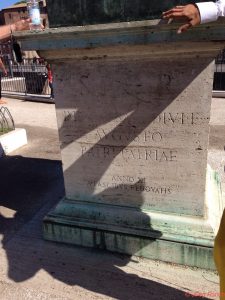
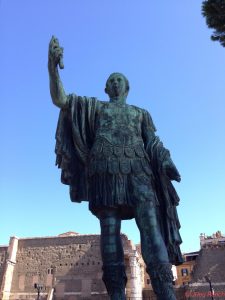
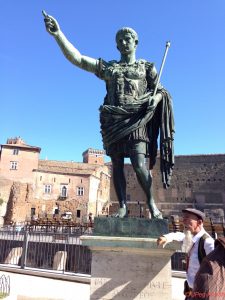
Picture by Peg Redwine

William Shakespeare had Marc Antony preach these words at Julius Caesar’s funeral:

“The evil that men do lives after them; the good is oft interred with their bones.”

Act III, Scene 2

Antony went on to list Caesar’s accomplishments in addition to his being ambitious. There was some good, some bad. Perhaps the citizens of Rome should have erected a partial statue of Caesar honoring just the good parts.

This could be a solution to our current controversy over monuments to historic figures. A committee could be composed of people who admire the works of a now dead leader and those who find the figure’s behavior flawed. A few examples might be helpful.

George Washington survived Valley Forge, presided over the Constitutional Convention and refused the opportunity to be named an emperor. On the other hand he owned hundreds of slaves and helped enshrine slavery into our legal system. The Committee might consider cutting the Washington Monument in half.

Thomas Jefferson was responsible for the Bill of Rights that guaranteed individual liberty but only to twenty-one year old white males. He also owned slaves and had children by one of them. Today such an employer/subject relationship would result in severe censure. Perhaps the Committee might recommend the Jefferson Memorial be closed every other week.

As we search for unblemished heroes to honor we could consider Abraham Lincoln who issued the Emancipation Proclamation. However, he at first averred slavery would be preferable to the disintegration of the Union and the Proclamation did not free all slaves just those in the states of the Confederacy. The Committee could maybe have a disclaimer added as a placard around his statue’s neck.

Andrew Jackson committed adultery, captured Seminole Indians under a flag of truce and as president created The Trail of Tears. On the other hand, he was a courageous and victorious military leader. A short bronze bust could replace his heroic sized statue.

As for Mount Rushmore the Committee would have to remove at least 3 of the 4 figures. Of course, Teddy Roosevelt had a penchant for shooting animals which might upset the ASPCA; so all 4 might have to be erased.

Right here in Posey County, Indiana we have a dilemma about what to do with our most famous citizen. Alvin Peterson Hovey was once Posey Circuit Court Judge, a Civil War general for the Union and our only governor. Unfortunately, he also was instrumental in helping to cover up the murders of seven Black men in October 1878. One of those Black men was shot and stuffed into a hollow tree on a farm owned by Hovey. Will the Committee have to remove the glowing patina from Hovey’s bronze in the Indiana State House?

One might look to Jesus as the paragon of virtue but even he got angry and threw the moneychangers out of the temple. He, also, voiced his hope that the cup of his great travail might pass from him. On the other hand, apparently no one knows what Jesus looked like unless one believes the Shroud of Turin is a clue. I guess the Committee would not be able to find any statues of Jesus to modify.

It appears that history has not provided us with any perfect examples to honor. Maybe the Committee will have to suggest that all statues be modified by substituting feet of clay.

Picture by Peg Redwine

Share this:

  • Share on Facebook (Opens in new window) Facebook
  • Share on X (Opens in new window) X
  • Email a link to a friend (Opens in new window) Email
  • Share on WhatsApp (Opens in new window) WhatsApp

Like this:

Like Loading…

Filed Under: America, Circuit Court, Democracy, Females/Pick on Peg, Gavel Gamut, Judicial, Law, Males, Posey County, Slavery, War Tagged With: Abraham Lincoln, abuse of women, Alvin Peterson Hovey, Andrew Jackson, ASPCA, Bill of Rights, Civil War general, Constitutional Convention, Emancipation Proclamation, emperor, feet of clay, flag of truce, George Washington, governor of Indiana, Indiana State House, James M. Redwine, Jefferson Memorial, Jesus, Jim Redwine, Julius Caesar, Marc Antony, moneychangers, monuments, Mount Rushmore, murders of seven Black men in October 1878, paragon of virtue, Posey Circuit Court Judge, Posey County Indiana, Rome, Seminole Indians, Shroud of Turin, slavery, statues, Teddy Roosevelt, the evil that men do lives after them; the good is oft interred with their bones, The Trail of Tears, Thomas Jefferson, Union, Valley Forge, Washington Monument, William Shakespeare

Cultural Cleansing

August 20, 2017 by Peg Leave a Comment

A nation is its culture and experience, its history. That is what determines its character. The same is true of the world. We learn or do not learn from the mistakes and accomplishments of ourselves and those who have preceded us. If we learn, we can accomplish more. If we do not learn, we may repeat mistakes. To learn from the past we must know and understand it. If we hide the past, we do not change what has happened but we may live to regret that we no longer remember it.

ISIS or ISIL, the Islamic State of Iraq or the Islamic State of Syria, has been culturally cleansing the ancient Middle East for several years. Its members are offended by statues, monuments and artifacts that once, before ISIS destroyed them, carried within them thousands of years of human knowledge and culture. ISIS could not bear to allow memories of ancient or even contemporary peoples who had the temerity to have different beliefs from ISIS. This is particularly puzzling with religious differences since ISIS’s belief system is based on its particular interpretation of Islam which could not have existed before Mohammad who lived from 570 A.D. to 632 A.D. Yet ISIS viciously attacks the artifacts and history of cultures thousands of years old.

Of course, ISIS as all such denigrators of history, is not changing the facts of history. ISIS is merely proving their own ignorance of it. Such actions are much as children who put their hands over their eyes or duck their heads under the covers in an attempt to convince themselves that because they do not see something it never existed. Or as ISIS and some other people do, they destroy historical artifacts and try to convince themselves and others that a certain history never happened. Of greater concern is the very real possibility their actions will lead to the loss by future generations of an opportunity to learn from that history.

To preserve and observe a historical artifact, a temple to Baal that was 5,000 years old or a Christian church that was 2,000 years old for example, is not to worship Baal or Jesus but is to build upon and learn from history. To destroy artifacts of a nation’s past does not change that past but it may result in the nation repeating past errors because those errors are out of sight and therefore out of mind.

History teaches us that power waxes and wanes and that who is on top today may be oppressed tomorrow. The burning or banning of books, say the Bible for example, does not invalidate a book’s content. It does validate the lack of vision of those who arrogate to themselves the sole interpretation of truth or history.

Each of us has the right to venerate or denigrate whatever philosophy, religion or creed we wish. However, just because what happened in history may be offensive to us does not mean we should attempt to establish such history never occurred. Haven’t we lived through enough of such culture destroying behavior to recognize the danger in such a course?

Perhaps next week we can revisit such a revision of history that occurred right here in Posey County, Indiana and delve into what that revision might mean to us today

Share this:

  • Share on Facebook (Opens in new window) Facebook
  • Share on X (Opens in new window) X
  • Email a link to a friend (Opens in new window) Email
  • Share on WhatsApp (Opens in new window) WhatsApp

Like this:

Like Loading…

Filed Under: America, Democracy, Gavel Gamut, Middle East, War Tagged With: artifacts, Bible, Christian church, cultural cleansing, ISIL, ISIS, Islamic State of Iraq, Islamic State of Syria, James M. Redwine, Jesus, Jim Redwine, Mohammad, monuments, nation's culture and experience, statues, temple to Baal

© 2026 James M. Redwine

Loading Comments...
%d